- *MSRP:
$21.49- Our Price:
- $19.34
- Subscribe and Save:
- $13.12ea.
- Buy: at $19.34


Taking high-dose Vitamin D3 on its own only solves half of the calcium puzzle. Discover how pairing Vitamin K2 Plus D3 creates an essential biological partnership that routes calcium straight into your bone matrix while actively protecting your cardiovascular system.
Medical Review: Evidence-based nutritional reviewCalcium is the building block of our skeletal system, but calcium cannot navigate your body on its own. Left unguided, supplemental calcium can drift into the soft tissues of your body—most notably the walls of your blood vessels and arteries—contributing to arterial stiffness and calcification.
Here is how the dynamic duo of Vitamin K2 Plus D3 keeps your system balanced:
Vitamin D3 (cholecalciferol) opens the doorway in your gut. It increases your intestine's ability to absorb dietary and supplemental calcium into the bloodstream. Without D3, calcium passes through you unabsorbed.
Once calcium enters the bloodstream, Vitamin K2 (as Menaquinone-7 or MK-7) directs where that calcium travels. K2 activates specialized proteins that grab free-floating calcium and lock it into your teeth and bones while keeping it out of your arteries.
The "Calcium Paradox": Taking high doses of Vitamin D3 without sufficient Vitamin K2 causes calcium to accumulate in the bloodstream without knowing where to go. Over time, this imbalance can lead to uncarboxylated proteins, soft-tissue calcification, and diminished cardiovascular elasticity.
Rather than relying on marketing claims, the synergy behind Vitamin K2 Plus D3 is anchored in robust human clinical trials and mechanistic biochemistry:
Osteocalcin is a hormone produced by bone-building osteoblasts. However, osteocalcin is synthesized in an inactive form. Vitamin K2 acts as an indispensable biochemical cofactor that "carboxlylates" osteocalcin, allowing it to bind to ionic calcium and integrate it into the hydroxyapatite crystal matrix of bone.
Clinical Study: In a landmark 3-year randomized, double-blind clinical trial involving 244 healthy postmenopausal women, daily supplementation with 180 mcg of Vitamin K2 (as MK-7) significantly reduced age-related bone mineral content and bone mineral density loss at both the lumbar spine and femoral neck compared to placebo.
Citation: Knapen MHJ, Drummen NE, Smit E, Vermeer C, Theuwissen E. Osteoporos Int. 2013;24(9):2499-2507. doi:10.1007/s00198-013-2325-6.
Inside your blood vessels, an essential protein called Matrix Gla Protein (MGP) serves as the human body’s most potent natural defense mechanism against vascular calcification. Just like osteocalcin, MGP remains completely dormant until activated by Vitamin K2. Once activated, MGP binds excess calcium circulating in vascular walls, preventing arterial stiffening.
Clinical Study: The Rotterdam Study, a multi-year population study of 4,807 participants, demonstrated that individuals with the highest dietary intake of natural menaquinone (Vitamin K2) experienced a 57% reduction in coronary heart disease mortality and a 52% reduction in severe aortic calcification.
Citation: Geleijnse JM, Vermeer C, Grobbee DE, et al. J Nutr. 2004;134(11):3100-3105. doi:10.1093/jn/134.11.3100.
Vitamin D3 stimulates the gene expression that manufactures both Osteocalcin and MGP, while Vitamin K2 provides the chemical key that switches those proteins on. Neither nutrient can perform its job efficiently in isolation.
Systematic Review: Peer-reviewed analysis confirms that joint co-supplementation of Vitamin D and K promotes significantly higher bone mineralization and vascular balance than taking either vitamin independently.
Citation: van Ballegooijen AJ, Pilz S, Tomaschitz A, Grübler MR, Verheyen N. Int J Endocrinol. 2017;2017:7454376. doi:10.1155/2017/7454376.
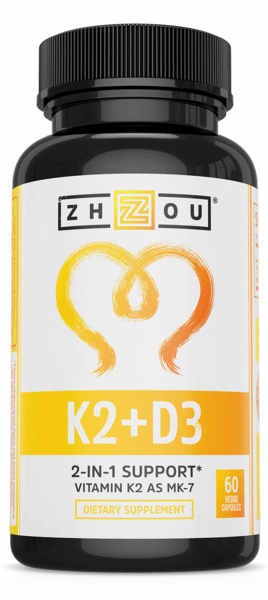
Transparency is paramount. Below is the complete, verified formulation for Zhou Nutrition Vitamin K2 Plus D3 (VitaNet SKU: 18z, UPC: 859805006188).
Serving Size: 1 Vegetable Capsule
Servings Per Container: 60
| Amount Per Serving | % Daily Value |
|---|---|
|
Vitamin D3 (as Cholecalciferol) (5,000 IU • Sourced from natural lanolin) |
125 mcg (625% DV) |
|
Vitamin K2 (as Menaquinone-7 / MK-7) (Derived from geraniol • All-trans bioavailable form) |
90 mcg (** Daily Value not established) |
Other Ingredients: Rice flour, vegetable cellulose (capsule).
Both Vitamin D3 and Vitamin K2 are fat-soluble micronutrients. To achieve optimal bioavailability, take one (1) vegetable capsule daily with a meal that contains healthy dietary fats (such as eggs, extra virgin olive oil, avocado, or nuts). Dietary lipids stimulate bile acid release, which dramatically improves intestinal transport into lymphatic circulation.
Not all Vitamin K is created equal. Many generic supplements use plant-based Vitamin K1 (phylloquinone) or synthetic short-chain Vitamin K2 (MK-4). Here is how they compare in the human body:
Reference: Schurgers LJ, et al. Blood. 2007;109(8):3279-3283. MK-7 exhibits a six-fold longer half-life than Vitamin K1 and provides more constant blood levels.
Taking Vitamin D3 alone allows your intestines to absorb calcium efficiently, but Vitamin D3 does not dictate where that calcium ends up. Without sufficient Vitamin K2 to activate calcium-binding proteins like osteocalcin and Matrix Gla Protein (MGP), calcium can linger in your circulatory system and accumulate in arterial walls rather than incorporating into your bones.
Vitamin K1 (phylloquinone) is found mostly in leafy greens and is processed by the liver to regulate blood clotting. Vitamin K2 (menaquinone) travels past your liver into extra-hepatic tissues, targeting your skeletal and vascular systems to regulate calcium distribution. Vitamin K2 as MK-7 also remains active in your bloodstream for up to 72 hours, compared to only 1 to 2 hours for Vitamin K1.
No. While many standard MK-7 supplements are fermented from soy (natto), Zhou Nutrition utilizes an advanced, nature-identical form of MK-7 derived from geraniol (derived from rose, palmarosa, and citronella oils). It is 100% soy-free, gluten-free, and tested for pure all-trans isomeric structure for optimal cellular recognition.
You must consult your doctor first. Warfarin (Coumadin) is a vitamin K antagonist that slows blood clot formation. Because supplemental Vitamin K2 directly interacts with clotting pathways, sudden changes in Vitamin K intake can alter your International Normalized Ratio (INR) levels. Always seek medical supervision before taking any Vitamin K product with anticoagulant drugs.
The best time to take your capsule is in the morning or early afternoon with a meal that contains healthy dietary fats (such as eggs, yogurt, nuts, or olive oil). Taking Vitamin D in the evening can occasionally disrupt melatonin synthesis and interfere with deep sleep in sensitive individuals.
Circulating serum 25(OH)D blood levels generally rise within 4 to 8 weeks of consistent daily supplementation. However, bone remodeling is a gradual biological process. Clinical studies evaluating bone mineral density (such as DEXA scans) measure structural changes over 6 to 36 months of consistent daily use.