
  |
SCFAs Improve Mitochondria Function Throughout The Body |
|
 SCFAs Improve Mitochondria Function Throughout The Body
|
Darrell Miller | 12/05/25 |
This content is for informational purposes only and is not a substitute for professional medical advice.


Date:
December 05, 2025 04:06 PM
Author: Darrell Miller
(support@vitanetonline.com)
Subject: SCFAs Improve Mitochondria Function Throughout The Body
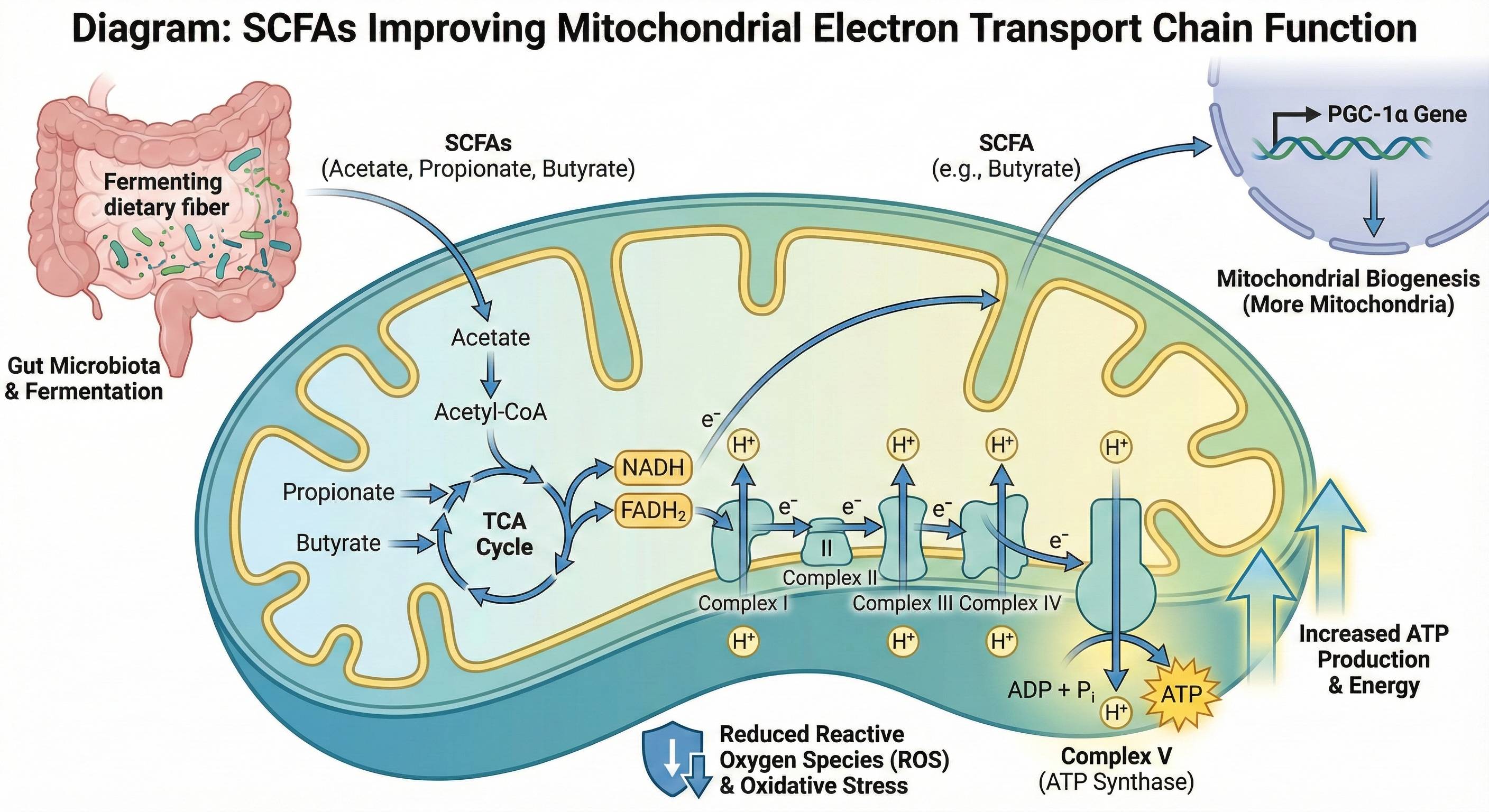
Yes, Short-Chain Fatty Acids (SCFAs) generally improve mitochondrial function throughout the body. While they are produced in the gut, they enter circulation and act as "signal boosters" for mitochondria in distant organs like the brain, liver, and muscles.
Quick Summary: How SCFAs Help Mitochondria
- Fuel Source: They can directly enter the Krebs cycle (the engine inside mitochondria) to produce ATP energy.
- Biogenesis: They trigger the creation of new mitochondria (a process called biogenesis) by activating a master regulator gene called PGC-1a.
- Stress Shield: They reduce oxidative stress, protecting mitochondria from damage.
Specific Benefits by Body Part
1. Skeletal Muscle (Energy & Endurance)
- What happens: Muscles are the largest consumer of energy in the body. SCFAs (especially butyrate and acetate) activate the AMPK pathway - a fuel gauge that tells muscle cells to burn fat and sugar more efficiently.
- Result: This leads to increased mitochondrial density (more mitochondria per cell) and better oxidative metabolism, which improves muscle endurance and insulin sensitivity.
2. Liver (Detox & Metabolism)
- What happens: The liver is the first stop for SCFAs after they leave the gut. Propionate and butyrate have been shown to reduce mitochondrial dysfunction caused by high-fat diets or toxins.
- Result: They lower oxidative stress (ROS) and prevent hepatocyte apoptosis (liver cell death), helping to protect against fatty liver disease.
3. Brain (Neuroprotection)
- What happens: SCFAs can cross the blood-brain barrier. Once there, they support the mitochondria of microglia (the brain's immune cells).
- Result: By keeping microglial mitochondria healthy, SCFAs help prevent neuroinflammation. They also protect the blood-brain barrier's endothelial cells from mitochondrial damage, which preserves cognitive health.
4. Brown Adipose Tissue (Fat Burning)
- What happens: Unlike "white fat" which stores energy, brown fat burns it. SCFAs (particularly acetate) stimulate UCP1, a protein in brown fat mitochondria that turns calories directly into heat (thermogenesis).
- Result: This increases whole-body energy expenditure and helps regulate body weight.
Key Mechanisms
- Epigenetic Regulation (HDAC Inhibition): SCFAs (mainly butyrate) inhibit enzymes called HDACs. This "unlocks" DNA, allowing cells to read the instructions for building more mitochondria.
- Receptor Signaling (GPCRs): SCFAs bind to specific receptors (FFAR2/FFAR3) on the surface of cells, sending a chemical text message that tells the cell to ramp up energy production.
Does boosting Mitochondria boost overall body energy production and help people feel better?
Yes, absolutely. Boosting mitochondrial function is one of the most effective ways to increase overall body energy and improve subjective well-being.Since mitochondria produce about 90% of the energy (ATP) your body uses, improving their function is like upgrading the engine in a car: you get more power, better fuel efficiency, and a smoother ride.
Here is the breakdown of how boosting mitochondria translates to "feeling better" physically and mentally.
1. The Physical Energy Boost (ATP Production)
When you improve mitochondrial density (the number of mitochondria) and efficiency (how well they work), you directly increase your "energy budget."- Less Fatigue: Dysfunctional mitochondria are a primary cause of fatigue. When they are "boosted," your cells can generate ATP faster than you burn it. This prevents that "heavy" feeling in your limbs and the mid-afternoon crash.
- Higher Stamina: With more healthy mitochondria, your muscles can rely on fat for fuel (oxidative phosphorylation) for longer periods before switching to sugar (glycolysis), which produces lactic acid and causes burnout. This means you can walk, work, or exercise longer without getting tired.
2. The Mental & Mood Boost (Neurotransmitters)
The brain consumes 20% of your body’s energy despite being only 2% of your weight. It is incredibly sensitive to mitochondrial health.- "Brain Fog" Clearance: When brain neurons don't get enough ATP, they fire more slowly, leading to brain fog and poor focus. Boosting mitochondria sharpens cognition and memory.
- Mood Regulation: Mitochondria are required to synthesize key neurotransmitters like serotonin (happiness) and dopamine (motivation).
- Research links mitochondrial dysfunction to anxiety and depression; conversely, fixing mitochondrial health often stabilizes mood.
- Resilience to Stress: Healthy mitochondria help buffer calcium and regulate cortisol. When they are functioning well, you are physically better at handling stress without feeling "burnt out."
3. How to "Boost" Them (Actionable Science)
You can stimulate Mitochondrial Biogenesis (growing new mitochondria) through specific signals:| Signal | Mechanism |
| Zone 2 Cardio | Long, slow exercise (where you can still hold a conversation) forces cells to build more mitochondria to burn fat efficiently. |
| HIIT | Short bursts of high intensity signal the body that it needs rapid energy, triggering the PGC-1a gene to build new mitochondria. |
| Cold Exposure | Brief exposure to cold (like a cold shower) stimulates "brown fat" mitochondria to generate heat, ramping up their activity. |
| Nutrients | CoQ10, PQQ, Magnesium, and B-Vitamins are essential co-factors. Without them, the mitochondrial machinery stalls. |
Connection to your previous question
This connects directly to the SCFAs we discussed. When your gut produces SCFAs (like butyrate), they travel to your brain and muscles and literally feed these mitochondria, helping them produce this energy.Which specific supplements (like PQQ or CoQ10) have the strongest clinical evidence for triggering mitochondrial biogenesis?
This is an exciting area of research because we now have human clinical trials showing we can actually "grow" new mitochondria (biogenesis) and clean out old ones (mitophagy) using specific compounds.Here are the top supplements with the strongest evidence for mitochondrial health, categorized by how they work.
1. The "Biogenesis" Trigger: PQQ (Pyrroloquinoline Quinone)
PQQ is currently the gold standard for generating new mitochondria.- The Evidence: Research indicates PQQ is up to 5,000 times more efficient at sustaining mitochondrial energy production than Vitamin C. A key study found that men taking 20mg of PQQ daily saw significant improvements in mitochondrial function and decreased inflammation (CRP) after just 6 weeks.
- Mechanism: It activates PGC-1a, the "master switch" gene that tells your cells to build more mitochondria from scratch.
- Best For: Long-term energy building and cognitive protection (preventing "brain fog").
2. The "Quality Control" Agent: Urolithin A
While PQQ builds new engines, Urolithin A recycles the old, broken ones.- The Evidence: Clinical trials (published in JAMA Network Open) have shown that Urolithin A supplementation significantly improved muscle endurance in older adults by improving mitochondrial health.
- Mechanism: It triggers Mitophagy. Over time, mitochondria get damaged and leak toxic byproducts. Urolithin A flags these broken mitochondria for destruction and recycling, ensuring only the healthy ones remain.
- Best For: Muscle endurance and healthy aging (slowing physical decline).
3. The "Fuel" Supplier: CoQ10 (Coenzyme Q10)
CoQ10 doesn't necessarily build new mitochondria, but the ones you have literally cannot work without it.- The Evidence: Extensive clinical trials, particularly in heart failure patients, show that CoQ10 improves the ejection fraction of the heart (a high-energy organ) by improving mitochondrial efficiency.
- Mechanism: It acts as an electron carrier in the Electron Transport Chain (the assembly line inside the mitochondria that makes ATP). Without enough CoQ10, the assembly line jams, and energy production stops.
- Synergy Note: PQQ + CoQ10 is a famous "stack." PQQ builds more mitochondria, and CoQ10 ensures they have the fuel to run.
- Best For: Immediate physical energy, heart health, and recovery from exercise.
4. The "Signal" Booster: Nicotinamide Riboside (NR)
This is a form of Vitamin B3 that boosts NAD+ levels.- The Evidence: A twin study showed that NR supplementation increased mitochondrial biogenesis in muscle tissue and improved gut microbiota composition.
- Mechanism: It raises levels of NAD+, a co-enzyme that activates Sirtuins. Sirtuins are proteins that protect DNA and regulate mitochondrial function, effectively "mimicking" the benefits of fasting or exercise.
- Best For: Metabolic health and systemic cellular repair.
Summary Table: What should you take?
| Supplement | Primary Goal | The "Action" |
| PQQ | Grow | Builds new mitochondria via PGC-1a gene. |
| Urolithin A | Clean | Recycles old/broken mitochondria (Mitophagy). |
| CoQ10 | Fuel | Essential worker on the energy assembly line. |
| NR (NAD+) | Signal | Boosts the chemical signal (NAD+) needed for repair. |
Optimizing mitochondrial health is a systemic strategy that links gut health to overall vitality, largely driven by Short-Chain Fatty Acids (SCFAs) like butyrate, which act as both fuel and signaling agents to enhance energy production in the brain, muscles, and liver. By stimulating mitochondrial biogenesis (the creation of new energy factories via the PGC-1a gene) and fueling the Electron Transport Chain, SCFAs - along with targeted supplements like PQQ, CoQ10, and Urolithin A - directly increase ATP output while simultaneously clearing out damaged cells through mitophagy. This biological upgrade results in tangible benefits, including sustained physical endurance, sharper cognitive focus, and stabilized mood, effectively turning the body’s cells into more efficient engines that produce more power with less oxidative "exhaust."