  |
Is It True That Eating More Sugar Means Absorbing Less Vitamin C? |
|
 Is it true the more sugar you eat, the less vitamin c you absorb?
|
Darrell Miller | 04/10/26 |
This content is for informational purposes only and is not a substitute for professional medical advice.


Date:
April 10, 2026 12:04 PM
Author: Darrell Miller
(support@vitanetonline.com)
Subject: Is it true the more sugar you eat, the less vitamin c you absorb?
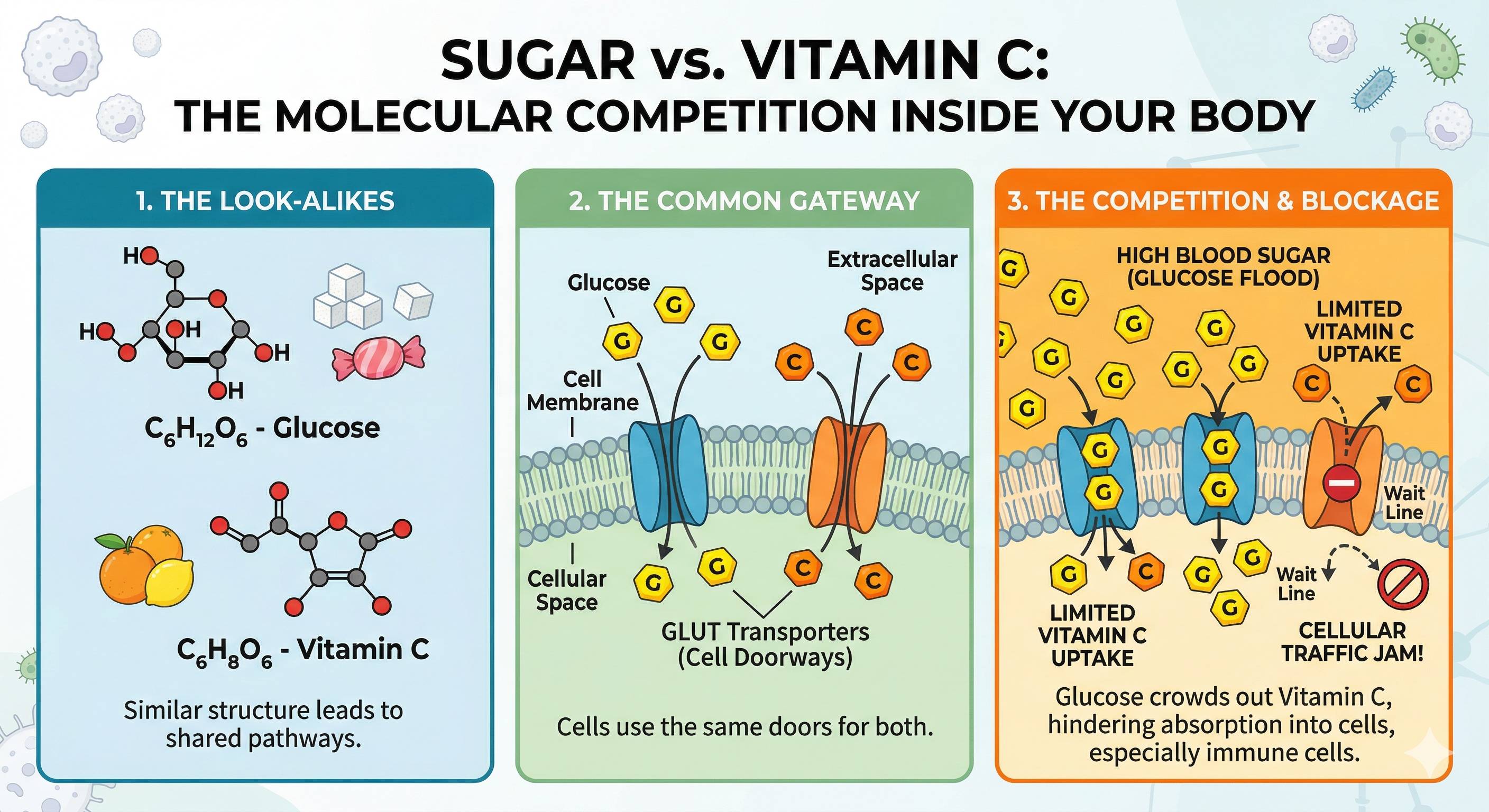
Yes, that is essentially true. The relationship between sugar (specifically glucose) and Vitamin C is a classic case of molecular competition.
Because their chemical structures are remarkably similar, they effectively fight for the same "doorways" into your cells.
The Molecular "Look-Alikes"
The primary reason for this competition is that Vitamin C (ascorbic acid) and glucose are structurally almost identical.- Glucose: C6H12O6
- Vitamin C: C6H8O6
The GLUT Transporter Competition
The main "doorways" used by both molecules are called Glucose Transporters (GLUT), specifically GLUT1 and GLUT3.When you consume a high amount of sugar, your blood glucose levels rise. This floods the area surrounding your cells with glucose molecules. Because the GLUT transporters have an affinity for both glucose and Vitamin C, they will prioritize the molecule that is more abundant.
The "Crowded Room" Analogy: Imagine a small door (the transporter) leading into a room (the cell). If there are 100 people wearing blue shirts (glucose) and only 2 people wearing orange shirts (Vitamin C) trying to get in at the same time, the blue shirts are statistically much more likely to make it through the door first.
Why This Matters for Your Health
This competition is particularly significant for the immune system. White blood cells require significantly higher concentrations of Vitamin C than the surrounding plasma to function effectively and fight off pathogens.- Immune Suppression: If blood sugar is chronically high (as seen in uncontrolled diabetes or diets very high in refined sugars), Vitamin C uptake into white blood cells can be significantly inhibited.
- The "C-Slowing" Effect: Research suggests that high glucose levels can slow down the "phagocytic index" - the rate at which white blood cells can engulf and destroy bacteria and viruses - partly because they lack the Vitamin C needed to fuel that process.
Summary of the Conflict
| Feature | Glucose | Vitamin C (Ascorbic Acid) |
| Source | Carbohydrates/Sugars | Fruits/Vegetables |
| Transport Mechanism | GLUT Transporters | GLUT & SVCT Transporters |
| Interaction | Competes for entry | Often "crowded out" by glucose |
| Result of High Sugar | High cellular glucose | Low cellular Vitamin C |
Vitamin C and glucose are chemical "look-alikes" that share nearly identical molecular structures - C6H12O6 for glucose and C6H8O6 for Vitamin C - leading them to compete for the same cellular gateways called GLUT transporters. When blood sugar levels rise, the sheer volume of glucose molecules effectively crowds out Vitamin C, prioritizing sugar transport and leaving cells, particularly white blood cells, deficient in the Vitamin C required for optimal function. This molecular competition means that high sugar intake doesn't just add calories; it creates a biological "traffic jam" that can significantly hinder your body's ability to absorb and utilize Vitamin C for immune support and repair.
Bio-Plex Buffered Vitamin C-500 100ct 500mg
C-1000 Two Stage TImed Release 250ct 1000mg
C-1000 With RH, Acerola, Bioflavonoids 100ct 1000mg
C-500 Two Stage Timed Release 250ct 500mg