  |
How Much Vitamin C Do You Actually Need at the First Sign of a Cold? |
|
 Why Do Sugar and Vitamin C Compete for the Same "Doorway" in Your Body?
|
Darrell Miller | 04/10/26 |
This content is for informational purposes only and is not a substitute for professional medical advice.


Date:
April 10, 2026 02:40 PM
Author: Darrell Miller
(support@vitanetonline.com)
Subject: Why Do Sugar and Vitamin C Compete for the Same "Doorway" in Your Body?
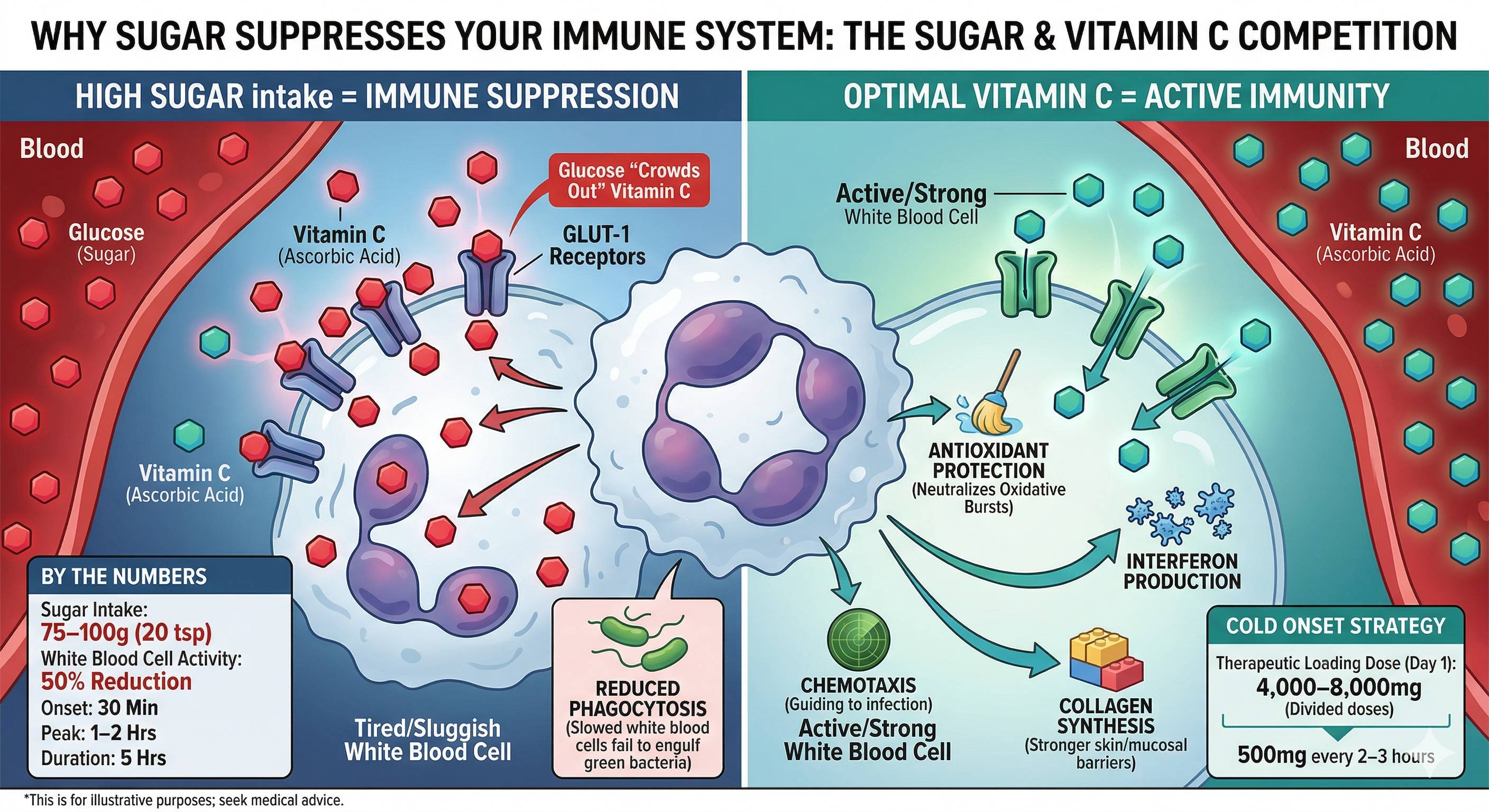
The relationship between sugar and the immune system is primarily centered on a concept called competitive inhibition. When you consume high amounts of sugar, it essentially "crowds out" the nutrients your immune cells need to function.
1. Why Sugar Suppresses the Immune System
The primary mechanism of sugar-induced immune suppression involves phagocytosis—the process by which white blood cells (specifically neutrophils and macrophages) engulf and "eat" harmful bacteria and viruses.- Phagocytic Inhibition: High levels of glucose in the bloodstream slow down these white blood cells. They become sluggish and less effective at identifying and destroying pathogens.
- Reduced Adhesiveness: Research suggests that high sugar levels reduce the "stickiness" of white blood cells, making it harder for them to attach to and exit blood vessels to reach the site of an infection.
2. Consumption Levels and Duration
Based on classic studies (notably the Sanchez et al. study from 1973), the "tipping point" for immune suppression is surprisingly low:| Metric | Detail |
| Consumption Level | 75 to 100 grams of sugar (approx. 20 teaspoons). For context, two 12oz cans of soda typically contain about 80g of sugar. |
| Magnitude of Effect | A reduction of up to 50% in the ability of white blood cells to engulf bacteria. |
| Onset | Suppression starts as soon as 30 minutes after ingestion. |
| Peak Effect | The greatest suppression occurs 1 to 2 hours after consumption. |
| Duration | The effect can last for up to 5 hours post-ingestion. |
3. Why Sugar Reduces Vitamin C Absorption
Sugar (glucose) and Vitamin C (ascorbic acid) are chemically very similar. In fact, most animals can synthesize Vitamin C directly from glucose. Because of this "molecular mimicry," they use the same "doorways" to enter your cells: the GLUT-1 receptors.- Competitive Binding: Your white blood cells have a high concentration of GLUT-1 receptors because they require massive amounts of Vitamin C to function. However, these receptors have a higher "affinity" for glucose.
- The "Crowding" Effect: If your blood is flooded with glucose, the receptors will prioritize the sugar, leaving the Vitamin C "locked out" of the cell. This means that even if you have enough Vitamin C in your blood, it can't get into the cells where it's actually needed.
4. How Vitamin C Supports the Immune System
Vitamin C is not just a general "booster"; it plays several highly specific roles in the immune response:- The "Mop" Effect (Antioxidant): When white blood cells attack a virus, they release "oxidative bursts" - essentially a form of biological bleach—to kill the pathogen. This bleach can also damage the immune cell itself. Vitamin C acts as a powerful antioxidant (a "mop") that neutralizes the excess bleach, protecting the immune cell so it can keep fighting.
- Chemotaxis: It helps "guide" immune cells to the site of infection faster, acting like a chemical GPS.
- Production of Interferon: Vitamin C helps the body produce interferons, which are proteins that signal the rest of the immune system to prepare for a viral attack.
- Collagen Synthesis: It is vital for building strong skin and mucosal barriers, which are the body's first line of defense against entering pathogens.
How much vitamin c should one consume if a cold comes on to effectively boost immune function ?
When a cold starts to settle in, your immune cells (especially those hungry white blood cells we talked about) begin to burn through Vitamin C at an accelerated rate. To "effectively" boost function during this window, you shift from a maintenance dose to what is often called a loading or therapeutic dose.1. The "Rescue" Dose (Symptom Onset)
Research (including a significant meta-analysis by Cochrane) suggests that while daily Vitamin C doesn't always prevent a cold, taking a high dose the moment you feel a scratchy throat can shorten the duration.- The "Day 1" Protocol: Some clinical studies have seen success with 4 to 8 grams (4,000-8,000 mg) on the very first day of symptoms.
- The Follow-up: After the first 24 hours, many protocols drop down to 2,000 mg daily until symptoms resolve.
2. The Golden Rule: Divided Doses
Your body has a "speed limit" for Vitamin C absorption. If you take 2,000 mg in one giant pill, your gut will likely rebel, and most of it will end up in the toilet.- Max Absorption: The body absorbs Vitamin C most efficiently in chunks of 500 mg or less.
- The Strategy: Instead of one big dose, take 500 mg every 2-3 hours. This keeps your blood levels saturated throughout the day rather than creating a single "spike and crash."
3. Finding Your "Bowel Tolerance"
In functional medicine, people often use the "Bowel Tolerance" method during illness. Because your body uses more Vitamin C when you're sick, your gut can actually handle higher doses than usual without issues.- The Signal: You gradually increase your dose (e.g., 1,000 mg every hour) until you experience gas or loose stools.
- The "Dose": Once you hit that point, you back off slightly. This is theoretically your body's way of saying, "I'm full; I can't use any more than this right now."
?? Important Reality Checks
- The Sugar Trap: If you take your Vitamin C in the form of sugary gummies or with a big glass of orange juice, you're re-introducing the competitive inhibition problem. The glucose in the juice will compete with the supplement for those GLUT-1 "doorways." Take it with water.
- The Upper Limit (UL): The official "Tolerable Upper Intake Level" for adults is 2,000 mg per day. Going significantly over this for more than a few days can cause diarrhea, nausea, and—in susceptible individuals—increase the risk of kidney stones (since excess Vitamin C is excreted as oxalate).
- Quality Matters: Look for "buffered" Vitamin C (like magnesium or calcium ascorbate) if you have a sensitive stomach; it’s less acidic than straight ascorbic acid.
Sugar intake directly hinders immune function by slowing down phagocytosis, the process where white blood cells destroy pathogens, with just 75 to 100 grams of sugar reducing this activity by up to 50% for approximately five hours. This occurs because glucose and Vitamin C share a nearly identical molecular structure and compete for the same GLUT-1 receptors to enter cells; when blood sugar is high, glucose "crowds out" Vitamin C, preventing immune cells from utilizing the nutrient for essential tasks like antioxidant protection and interferon production. To effectively bolster the immune response at the onset of a cold, it is recommended to take a therapeutic loading dose of Vitamin C - roughly 4,000 to 8,000 mg in divided 500 mg increments throughout the first day - while strictly limiting sugar intake to ensure the Vitamin C can successfully navigate these cellular doorways.
Bio-Plex Buffered Vitamin C-500 100ct 500mg
C-1000 With RH, Acerola, Bioflavonoids 100ct 1000mg
C-500 Two Stage Timed Release 100ct 500mg