
  |
Unlocking Your Cellular Vitality: Understanding the Role of Mitochondria in Energy and Aging |
|
 Unlocking Your Cellular Vitality: Understanding the Role of Mitochondria in Energy and Aging
|
Darrell Miller | 09/09/26 |
This content is for informational purposes only and is not a substitute for professional medical advice.


Date:
September 09, 2026 05:22 PM
Author: Darrell Miller
(support@vitanetonline.com)
Subject: Unlocking Your Cellular Vitality: Understanding the Role of Mitochondria in Energy and Aging
Introduction: Understanding Cellular Aging and Energy Decline
Have you ever wondered why you could bounce back from an all-nighter or an intense workout in your twenties, but in your forties or fifties, the same physical effort leaves you feeling drained for days?Most people think aging is something that happens strictly on the outside - fine lines around the eyes, stiff joints, or gray hairs. In reality, aging begins at a microscopic scale inside your cells, the microscopic building blocks that make up every tissue, muscle, and organ in your body.
Every single day, your body relies on roughly 30 trillion cells working in unison. When your cells are young and resilient, they operate like a well-oiled machine: they repair minor damage instantly, clear away waste, and produce abundant energy. But over time, two fundamental biological shifts take place:
- Your cellular power plants start slowing down, reducing the steady flow of energy your body needs to thrive.
- Damaged cells refuse to recycle themselves, lingering behind and creating biological friction for healthy neighbors.
The Role of Mitochondria and ATP Production
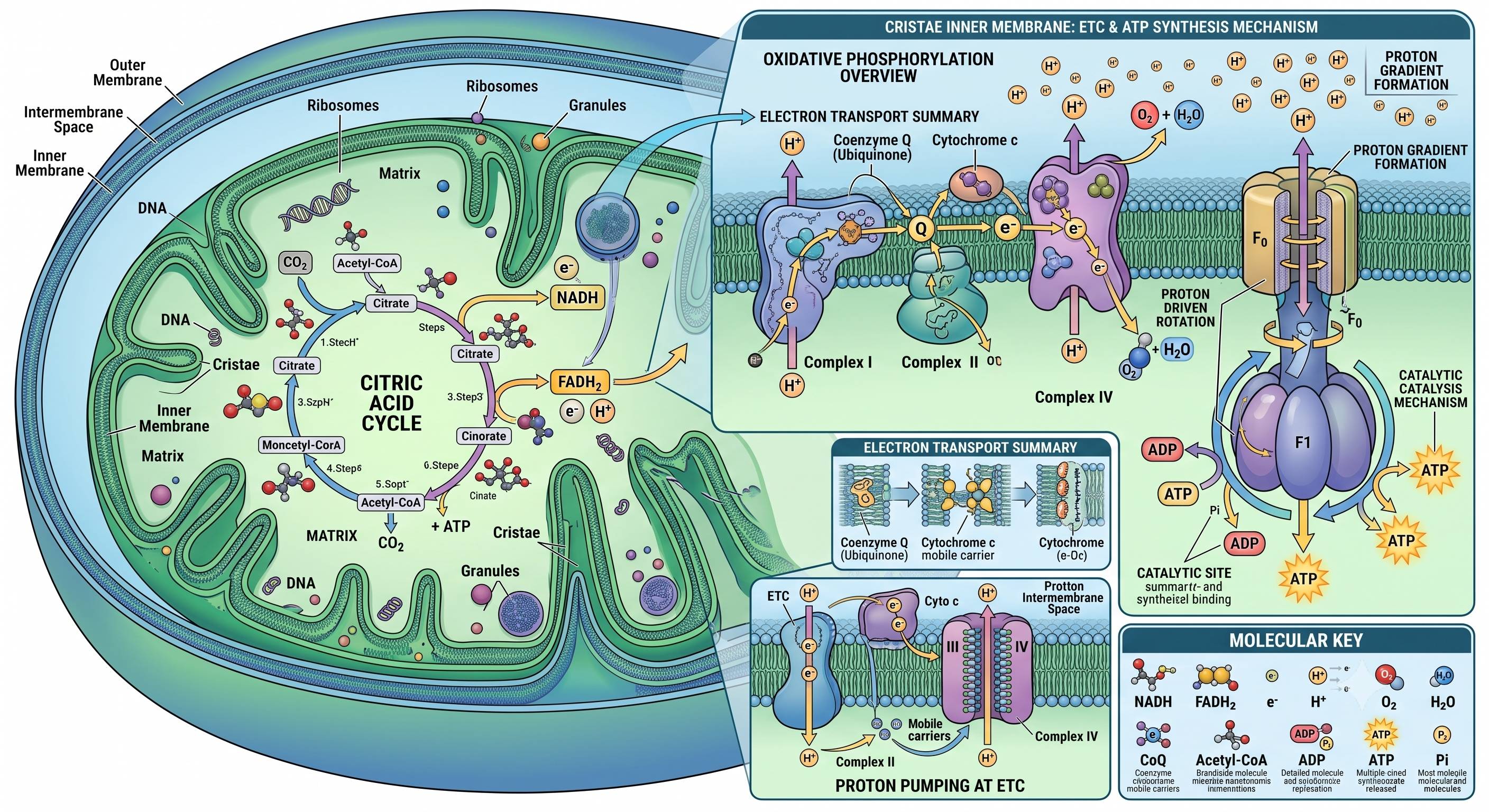
To understand where your daily energy comes from, you have to look inside your cells at tiny structures called mitochondria.Often called the "powerhouses" of the cell, mitochondria function like miniature power stations. A single cell can house hundreds or even thousands of them, especially energy-hungry cells like those in your heart, brain, and skeletal muscles.
The Body’s Energy Currency: What is ATP?
Your body cannot directly use a sandwich or a cup of coffee to power muscle contractions or brain signals. Instead, your mitochondria take the nutrients from your food and combine them with the oxygen you breathe to manufacture a chemical molecule called adenosine triphosphate (ATP).Think of ATP as your body’s universal energy currency:
- Every heartbeat "spends" ATP.
- Every thought, muscle contraction, and cellular repair job requires a steady supply of ATP coins.
- In the folds of the inner mitochondrial membrane (the cristae pictured above), microscopic protein motors called ATP synthase act like tiny hydroelectric turbines, churning out billions of ATP molecules every second.
Why Cellular Energy Production Declines with Age
When you are young, your mitochondria are abundant, pristine, and remarkably efficient. However, the very process of creating energy comes with an unavoidable side effect: oxidative stress.Much like an engine produces exhaust fumes while burning fuel, mitochondria produce reactive byproducts known as free radicals (reactive oxygen species). Over decades, these "exhaust fumes" slowly damage the inner machinery of the mitochondria:
- Mitochondrial DNA Damage: Unlike other parts of the cell, mitochondria possess their own distinct DNA, which sits right next to where the oxidative "exhaust" is released. Because this DNA lacks the robust defense systems of your main cellular nucleus, it accumulates wear and tear faster.
- Leaky, Less Efficient Turbines: Damaged mitochondria struggle to produce ATP at full capacity. Instead of generating clean energy, they burn fuel inefficiently and generate even more oxidative stress.
- Reduced Mitochondrial Number: As damaged mitochondria break down faster than the cell can replace them, the total number of working power generators inside each cell drops.
How Cellular Senescence Accelerates the Aging Process
If mitochondrial decline is a problem of power shortage, cellular senescence is a problem of biological clutter and pollution.In a healthy body, normal cells follow a strict lifecycle: they divide, perform their jobs, and when they incur significant damage or reach the end of their useful lifespan, they undergo a tidy self-destruction process called apoptosis (programmed cell death). Your immune system then clears away the debris, making room for fresh, vibrant cells.
Cellular senescence happens when this cleanup process fails.
The "Zombie Cell" Phenomenon
When a cell experiences extreme stress - such as shortened telomeres (the protective caps on chromosomes), severe DNA breaks, or severe mitochondrial dysfunction - it reaches a biological crossroads. To prevent the damaged cell from dividing uncontrollably (which could lead to tumors), the body puts the brakes on.The cell enters a permanent state of dormancy:
- It permanently stops dividing.
- Crucially, it refuses to die.
Why Zombie Cells Are So Damaging: The Bad Apple Effect
Having a few retired cells hanging around might not sound catastrophic, but senescent cells do not sit quietly. Instead, they secrete a toxic chemical cocktail known as the Senescence-Associated Secretory Phenotype (SASP).This cocktail is packed with pro-inflammatory cytokines, chemokines, and tissue-degrading enzymes. Picture one spoiled apple sitting in a fruit basket: the ethylene gas it emits quickly causes the healthy apples surrounding it to rot.
In the same way, the toxic secretions from zombie cells:
- Spread the Damage: They trigger inflammation and induce premature senescence in healthy neighboring cells.
- Break Down Healthy Tissue: The enzymes degrade the extracellular matrix (the collagen and elastin scaffolds that keep skin firm and arteries flexible).
- Exhaust the Immune System: Your immune cells are dispatched to manage the constant, low-grade alarm signals, gradually wearing out your natural defense network.
The Vicious Cycle of Cellular Aging
Mitochondrial decay and cellular senescence are not isolated events; they feed directly into one another:| Cellular Component | The Healthy State | The Aging State | Everyday Customer Impact |
| Mitochondria | Abundant, high ATP output, minimal oxidative leaks | Fewer power plants, high free-radical leakage | Low stamina, brain fog, slow workout recovery |
| Cellular Turnover | Old cells self-destruct (apoptosis) and get recycled | Damaged cells linger as senescent "zombie cells" | Tissue stiffness, chronic low-grade inflammation |
| Tissue Environment | Clean, cooperative, nutrient-rich cellular matrix | Bathed in inflammatory secretions (SASP) | Premature aging of skin, joints, and organs |
What This Means for Everyday Health
The good news from modern longevity science is that cellular decline is not entirely out of our hands. While aging is natural, the rate at which our cellular engines degrade can be influenced by daily habits:- Exercise Stimulates New Power Plants: High-intensity intervals and resistance training trigger a process called mitochondrial biogenesis - prompting your cells to build brand-new, clean-burning mitochondria.
- Fasting & Caloric Balance Trigger Autophagy: Periods between meals signal cells to clean house, breaking down dysfunctional proteins and clearing away debris.
- Targeted Micronutrients & Antioxidants: Supporting key cellular cofactors (such as NAD+, CoQ10, and polyphenols) helps shield mitochondrial membranes from oxidative strain and supports the body's natural cellular renewal pathways.
Summary:
Aging is fundamentally a microscopic process occurring inside the body's trillions of cells, which naturally become less resilient over time. Central to this decline are the mitochondria, the tiny structures that function as the cell's "power plants" to produce adenosine triphosphate (ATP), the universal chemical currency for everyday energy. While young mitochondria are abundant and pristine, decades of producing ATP generate oxidative stress through byproducts called free radicals, which eventually wear down and damage mitochondrial DNA and machinery. This damage results in fewer, less efficient power generators, lowering total cellular energy output, which individuals experience as real-world physical fatigue and mental fog.
Aging is further accelerated by cellular senescence, a condition where damaged cells stop dividing but, instead of naturally self-destructing like healthy ones, linger behind as dormant "zombie cells." These senescent cells secrete a pro-inflammatory chemical mixture known as the Senescence-Associated Secretory Phenotype (SASP), which functions like a "bad apple" by poisoning healthy neighboring cells and tissues, creating a state of chronic biological pollution termed "inflammaging." Mitochondrial decay and senescence feed into one another in a vicious cycle that directly drives overall aging. However, longevity science highlights that healthy lifestyle habits, including regular exercise and periods of fasting, can support continued vitality by encouraging the development of new mitochondria and the clearing of this toxic cellular clutter.