- *MSRP:
$14.99- Our Price:
- $8.70
- Buy: at $8.70


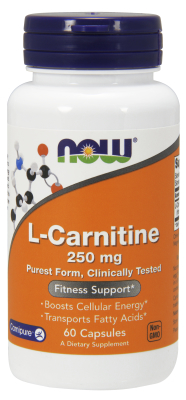
NOW Foods Carnitine 250mg supplies a clinically tested, pharmaceutical-grade source of free-form L-carnitine designed to optimize cellular energy production, fat metabolism, and muscular endurance. Each single vegetarian capsule delivers 250 mg of pure, elemental L-carnitine derived from 373 mg of patented Carnipure® L-carnitine tartrate (providing 500 mg of elemental L-carnitine per standard two-capsule serving). Whether you are an athlete looking to speed up exercise recovery or someone seeking clean, non-stimulant metabolic fuel, this formula delivers high-potency cellular support in an easy-to-digest vegetable capsule.
In plain terms, think of L-carnitine as your body's cellular “shuttle bus.” Your cells cannot directly burn long-chain fats for fuel until those fats get carried inside the cell's microscopic energy factories, known as mitochondria. L-carnitine attaches to fatty acids and transports them across the mitochondrial wall where they are converted into adenosine triphosphate (ATP)—the universal energy currency of your body.
L-carnitine is a conditionally essential quaternary amine synthesized in the liver and kidneys from the essential amino acids L-lysine and L-methionine, with cofactors including vitamin C, vitamin B6, niacin, and iron. While the body naturally manufactures small quantities, skeletal muscle and cardiac tissues contain approximately 95% to 98% of total bodily carnitine stores because these tissues rely heavily on fatty acid oxidation for ongoing mechanical work.
The inner membrane of the mitochondria is impermeable to long-chain fatty acids (LCFAs). To cross this barrier, fatty acids must undergo transesterification via the Carnitine Palmitoyltransferase (CPT) enzyme system. On the outer mitochondrial membrane, CPT-1 couples carnitine to long-chain acyl-CoA molecules, forming acylcarnitine. A specialized carrier protein, Carnitine-Acylcarnitine Translocase (CACT), ferries acylcarnitine across the inner membrane into the inner matrix. Once inside, CPT-2 regenerates free L-carnitine and releases acyl-CoA directly into the beta-oxidation cycle. This enzymatic cycle yields abundant acetyl-CoA to power the Krebs cycle and oxidative phosphorylation, generating ATP.
During intense exercise, high rates of glycolysis create an overaccumulation of acetyl groups inside the mitochondria, which inhibits pyruvate dehydrogenase (PDH)—the gatekeeper enzyme for carbohydrate oxidation. Carnitine Acetyltransferase (CAT) buffers these excess acetyl groups by converting carnitine into acetylcarnitine. This buffering mechanism maintains an adequate pool of free Coenzyme A (CoA), preventing cellular bottlenecks and permitting prolonged athletic output.
Supplementing with L-carnitine tartrate increases blood flow and microvascular perfusion to working muscles, reducing exercise-induced hypoxia. By protecting cellular membranes from lipid peroxidation, carnitine significantly attenuates post-workout circulating markers of structural muscle damage, including serum creatine kinase (CK), lactate dehydrogenase (LDH), and malondialdehyde (MDA).
Every bottle of NOW Foods Carnitine 250mg adheres strictly to transparent labeling standards. The front label highlights 250 mg per capsule of pure elemental L-carnitine, while the official FDA Supplement Facts panel reflects the manufacturer's suggested 2-capsule serving size (500 mg total).
| Serving Size: 2 Veg Capsules | Servings Per Container: 30 |
|---|---|
| Active Nutrient | Amount Per Serving (% Daily Value) |
| L-Carnitine (Carnipure®) (from 746 mg L-Carnitine Tartrate; supplies 250 mg elemental L-carnitine per capsule) |
500 mg * Daily Value not established |
Allergen Declaration: Not manufactured with wheat, gluten, soy, corn, milk, egg, fish, shellfish, tree nut, or sesame ingredients. Produced in an NPA-certified and FDA-registered GMP facility that processes other ingredients containing these allergens.
Certifications: Non-GMO Project Verified, Vegan/Vegetarian certified, Kosher (Triangle K), Halal (Crescent H), and GMP Quality Assured. Carnipure® is a registered trademark of Lonza Ltd., Switzerland.
In the dietary supplement marketplace, amino acid sourcing demands intense laboratory scrutiny. Low-grade, generic carnitine syntheses can accidentally yield racemic mixtures containing the synthetic mirror isomer D-carnitine. D-carnitine is biologically inactive and competes directly with native L-carnitine for cellular transport proteins, potentially inducing carnitine deficiency and neuromuscular fatigue. NOW Foods eliminates this risk by using pure Carnipure® tartrate and testing every production run through rigorous in-house analytical workflows.
NOW Foods operates one of the most comprehensive private analytical testing testing complexes in North America, spanning corporate facilities in Bloomingdale, Illinois, and Sparks, Nevada. Their scientists perform more than 19,000 separate tests each month, maintaining strict ISO/IEC 17025 accreditation for testing calibration, accuracy, and reproducibility.
High-Performance Liquid Chromatography (HPLC) and Ultra-High Performance Liquid Chromatography (UHPLC) verify exact potency and ensure 100% optical purity. Every finished batch of NOW Carnitine 250mg is tested to confirm that it contains only the pure L-isomer, with 0% detectable D-carnitine contamination.
Raw materials and final encapsulated batches are screened via ICP-MS for toxic heavy metals down to trace parts-per-billion (ppb) thresholds:
Advanced automated DNA-based real-time Polymerase Chain Reaction (PCR) and biological plating confirm that raw batches are completely free of pathogenic microbes, including Escherichia coli, Salmonella species, Staphylococcus aureus, Pseudomonas, and environmental mold or yeast spores. NOW maintains an A-rated Good Manufacturing Practices (GMP) certification through the Natural Products Association (NPA) and holds dietary supplement manufacturing certification from Underwriters Laboratories (UL).
NOW Foods L-Carnitine 250 mg delivers clinically verified, pharmaceutical-grade Carnipure® to support cellular energy production, exercise recovery, and natural fat metabolism. Naturally classified as a non-essential amino acid derivative, L-carnitine acts as an essential carrier molecule inside human cells. Its primary biological job is to grab long-chain fatty acids from your bloodstream and transport them across mitochondrial membranes into your cellular "furnaces," where fats are oxidized and converted directly into usable cellular energy (adenosine triphosphate, or ATP).
While the body synthesizes small amounts of carnitine from the essential amino acids lysine and methionine, bodily tissues with high metabolic demand—especially skeletal muscle, the heart, and the vascular system—depend on steady cellular carnitine pools. The 250 mg capsule format provides an ideal, highly titratable dosage. Instead of flooding your digestive system with excessive single doses that saturate gut receptors, 250 mg allows precise, divided intake tailored to individual dietary needs, athletic regimens, or plant-based nutritional profiles.
To appreciate how L-carnitine functions, imagine your muscle and heart cells as power plants. Fats (fatty acids) are the primary, sustained fuel source for these plants, but they cannot enter the inner power generators (the mitochondria) on their own. The mitochondrial inner membrane is completely impermeable to long-chain fatty acids.
L-carnitine serves as the physical shuttle truck in a biological process known as the carnitine palmitoyltransferase (CPT) enzyme shuttle system:
Why the 250 mg Fractionated Serving Matters: In human intestinal physiology, carnitine is absorbed across the mucosal wall via sodium-dependent organic cation transporters (specifically OCTN2). Peer-reviewed pharmacokinetic data published in the Annals of the New York Academy of Sciences demonstrates that when dietary carnitine is ingested in lower, fractionated quantities (such as 250 mg to 500 mg), mucosal absorption efficiency remains high (approaching 60% to 75%). Conversely, single massive megadoses (2,000 mg to 3,000 mg) completely saturate the OCTN2 active transport pathway, causing absorption rates to drop as low as 14% to 18%, leaving large unabsorbed amounts in the lower bowel to be degraded into unwanted metabolic byproducts by intestinal bacteria.
Scientific Literature References:Transparency in labeling ensures you know precisely what goes into your body. NOW® utilizes Carnipure® crystalline L-carnitine tartrate, manufactured via a patented biocatalytic process that guarantees zero chemical contamination from synthetic stereoisomers.
| Nutritional Metric | Specification Per Serving |
|---|---|
| Serving Size | 2 Veg Capsules |
| Servings Per Container | 30 Servings (60 Capsules Total) |
| L-Carnitine (Carnipure®) (from 735 mg L-Carnitine Tartrate) |
500 mg (250 mg pure base per capsule) |
| Daily Value (%DV) | * Daily Value not established |
Other Ingredients: Hypromellose (cellulose capsule), Microcrystalline Cellulose, Stearic Acid (vegetable source), and Silicon Dioxide.
Allergen Free & Clean Guarantee: Not manufactured with wheat, gluten, soy, milk, egg, fish, shellfish, tree nut, or sesame ingredients. Produced in a GMP facility that processes other ingredients containing these allergens. Non-GMO, Vegan/Vegetarian certified, Halal, and Kosher.
In the dietary supplement marketplace, commodity raw ingredients can vary significantly in purity, potency, and cleanliness. NOW Foods maintains one of the most comprehensive private analytical laboratories in North America, operating advanced testing facilities in Bloomingdale, Illinois, and Sparks, Nevada, that are fully ISO/IEC 17025:2017 accredited.
Every production batch of NOW L-Carnitine 250 mg is subjected to strict quality verifications to protect consumers from environmental toxins and adulteration:
Optimizing the physiological benefits of L-carnitine depends significantly on biological timing, nutrient co-ingestion, and clinical awareness.
As a dietary supplement, take 1 to 2 veg capsules 1 to 3 times daily. Because cellular uptake into skeletal muscle is mediated by insulin-stimulated transporter activity, ingesting L-carnitine alongside a modest meal containing carbohydrates or complete proteins markedly enhances retention within muscle tissue compared to taking it on an empty stomach.
Hypothyroidism & Thyroid Medication: L-carnitine acts as a peripheral antagonist to thyroid hormone action by inhibiting thyroid hormone entry into the cell nucleus (Bacci et al., 1982). Individuals with hypothyroidism or those taking levothyroxine should consult their endocrinologist prior to use.
Seizure Disorders: High doses of carnitine have been reported to increase seizure frequency in susceptible individuals with pre-existing seizure disorders.
Anticoagulant Therapy: L-carnitine may enhance the blood-thinning effects of Warfarin (Coumadin) or other anticoagulant medications. Routine INR monitoring is advised if initiating carnitine supplementation.
Choosing where to buy dietary supplements is as important as the supplements you take. VitaNet®, LLC is an independent, family-owned natural health business founded in 1995 and rooted in Hartville, Ohio[cite: 1]. With over 31 years of dedicated hands-on experience, we bridge nutritional biochemistry with accessible, everyday discount value[cite: 1].
L-Carnitine 250 mg is used to assist cellular fat metabolism, enhance endurance, and support healthy muscle recovery. It shuttles long-chain fatty acids into mitochondria to be burned for fuel, making it popular among active fitness enthusiasts, individuals seeking metabolic support, and vegans who do not obtain sufficient carnitine from dietary meat.
Intestinal absorption of carnitine via OCTN2 transporters is saturable. Taking lower, fractionated doses of 250 mg to 500 mg ensures high absorption efficiency (up to 75%) while preventing gut irritation. In contrast, large single doses flood the intestine, resulting in low absorption rates and gastrointestinal upset.
While standard L-carnitine primarily targets peripheral tissues such as skeletal muscle, cardiac tissue, and mitochondrial fat oxidation throughout the body, Acetyl-L-Carnitine (ALCAR) contains an added acetyl group that allows it to cross the blood-brain barrier readily, making ALCAR better suited for neurological and cognitive focus.
Carnipure® is a premium, patented form of pure L-carnitine manufactured by the Swiss company Lonza. It is produced using an advanced enzymatic fermentation process that yields 100% active L-enantiomer, completely free of harmful synthetic D-carnitine isomers.
For optimal muscle absorption, take L-carnitine with a meal containing carbohydrates or lean protein, or consume it 30 to 45 minutes prior to exercise. Insulin secreted during meal digestion activates cellular transporters, significantly boosting carnitine delivery into muscle cells.


