|
Search Term: " Methylfolate "
Does Methylation Effect Active Vitamin D3 Levels in the body?   
Date:
July 08, 2026 12:43 PM
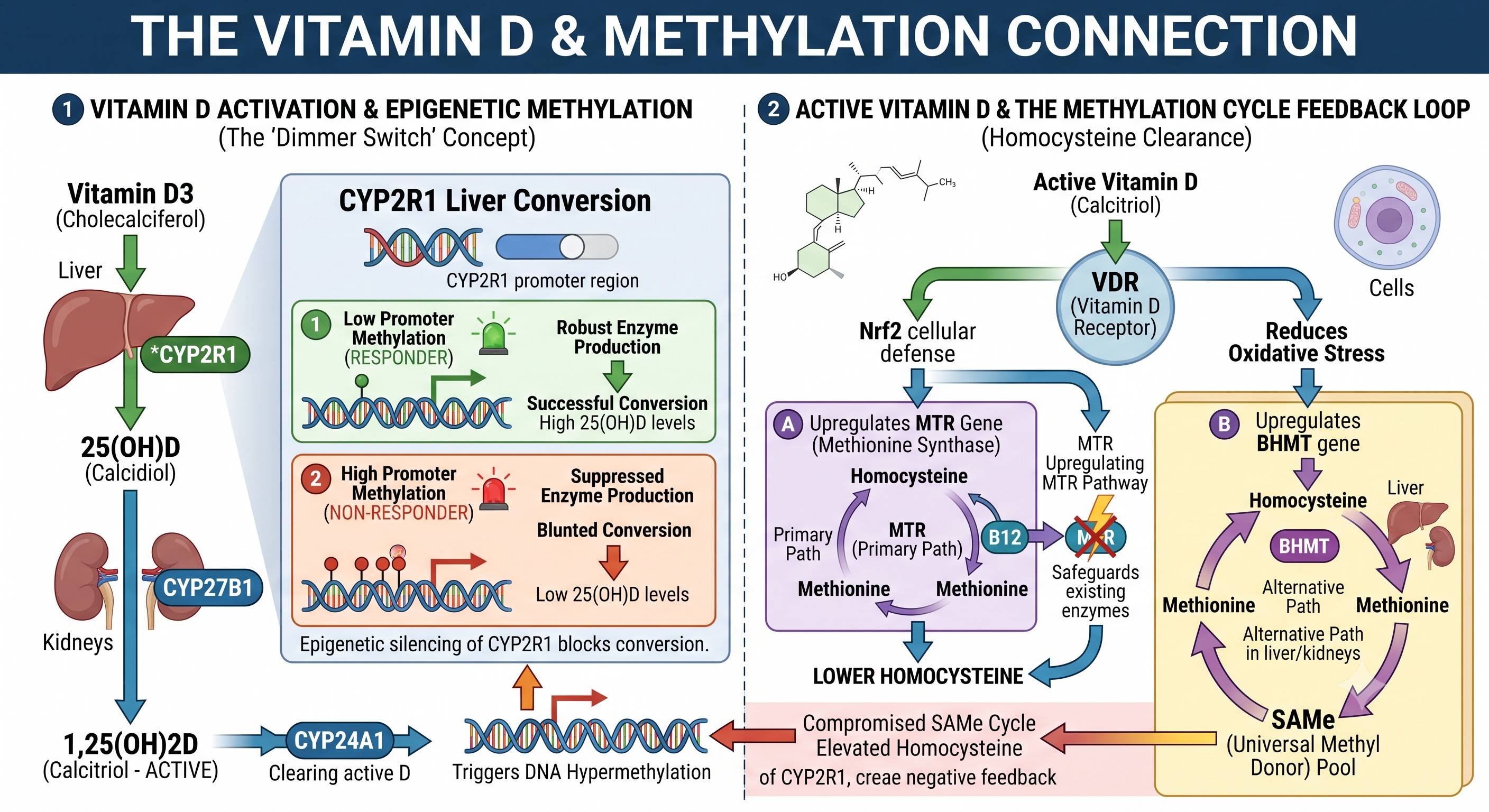
Yes, methylation directly and significantly impacts how efficiently your body converts Vitamin D3 into its active, usable form. This relationship operates on two distinct levels: epigenetic DNA methylation (which acts as a volume knob for the conversion enzymes) and the cellular methylation cycle (which shares a profound reciprocal feedback loop with active Vitamin D). To see exactly where methylation interferes, it helps to look at the standard two-step activation pathway:
1. DNA Methylation (The Epigenetic "Dimmer Switch")DNA methylation is an epigenetic mechanism where methyl groups are attached to a gene's promoter region, typically silencing or "turning down" its expression.
2. The Systemic Methylation Cycle Feedback LoopWhile S-adenosylmethionine (SAMe) is not a direct chemical cofactor required for the hydroxylation reactions themselves (which rely on NADPH and the cytochrome P450 enzyme network), the systemic methylation cycle and Vitamin D share a massive reciprocal cross-talk mechanism.
The Vitamin D "Non-Responder": Is Your DNA Dimming Your Supplement’s Power? Yes, higher active Vitamin D3 levels consistently cause homocysteine levels to drop. Large-scale observational studies and gold-standard randomized controlled trials (RCTs) confirm a distinct, inverse relationship: as your Vitamin D status optimizes, circulating total homocysteine decreases. When active D3 binds to the Vitamin D Receptor (VDR), it triggers specific genetic and cellular actions that clear homocysteine through multiple pathways. The Biological MechanismsActive Vitamin D doesn’t just lower homocysteine through one pathway; it exerts a multi-pronged push to keep the toxic amino acid from accumulating.1. Upregulation of Methionine Synthase (MTR)While active D3 supports the alternative BHMT (betaine) pathway, recent molecular research highlights an even more direct impact on the primary, folate-dependent remethylation loop.
2. Safeguarding Enzyme Function via Oxidative Stress ReductionThe primary enzyme responsible for clearing homocysteine, Methionine Synthase, is incredibly sensitive to oxidative stress. Under high inflammation or oxidative conditions, the cobalt atom at the heart of its B12 cofactor becomes oxidized, completely disabling the enzyme and causing a major homocysteine backup.
3. Preserving Liver and Kidney FunctionThe alternative remethylation pathway, BHMT, operates almost exclusively in the liver and kidneys. If these organs experience structural or metabolic strain, their capacity to process homocysteine drops drastically. Active Vitamin D protects hepatic and renal tissue architecture, ensuring the local cellular machinery required for the betaine-homocysteine conversion remains functional.What the Clinical Trials ShowIn human trials, the drop isn't just theoretical - it's highly measurable.The Clinical Evidence: In double-blind, randomized, placebo-controlled trials, individuals with low baseline Vitamin D and elevated homocysteine were given high-dose Vitamin D3 (e.g., 50,000 IU weekly) over a two-month period. The treatment groups consistently showed statistically significant drops in total serum homocysteine, alongside reductions in body mass index (BMI) and systemic inflammatory markers, while the placebo groups saw no change. If someone is dealing with stubborn hyperhomocysteinemia (elevated homocysteine) and pushing hard on methylated B-vitamins (like Methylfolate and TMG/betaine) without seeing their numbers budge, a hidden Vitamin D deficiency or a high-methylation genetic barrier at the CYP2R1 liver enzyme is very frequently the missing link. Summary: The relationship between Vitamin D3 activation and the body's biochemical pathways operates as a highly coordinated, reciprocal feedback loop. On an epigenetic level, DNA methylation acts like a cellular dimmer switch for the liver enzyme CYP2R1, which is responsible for converting raw D3 into its circulating form. When the promoter region of this gene is heavily methylated, enzyme production is suppressed, explaining why some individuals act as clinical "non-responders" who struggle to raise their blood levels even with high-dose supplementation. Once Vitamin D is successfully activated, however, it turns around and directly reinforces the systemic methylation cycle by binding to the Vitamin D Receptor (VDR) and upregulating the BHMT gene, which is vital for maintaining the body's universal methyl donor (SAMe) pool. Conversely, maintaining robust levels of active Vitamin D3 plays a direct, clinically proven role in forcing circulating homocysteine levels to drop. When active D3 binds to its receptor, it triggers a multi-pronged clearance strategy by activating the Nrf2 cellular defense pathway, which upregulates Methionine Synthase (MTR) - the primary enzyme that converts toxic homocysteine back into harmless methionine. Furthermore, by acting as a powerful systemic anti-inflammatory, active Vitamin D lowers the oxidative stress that would otherwise oxidize and disable the delicate B12 cofactors inside these clearance enzymes. This dual action of increasing enzyme production while shielding existing enzymes from environmental damage explains why clinical trials consistently show significant reductions in serum homocysteine when Vitamin D status is optimized.
(https://vitanetonline.com:443/forums/Index.cfm?CFApp=1&Message_ID=6644) Beyond Choline: How DMAE Flushes Cellular Waste for Longevity 
Date:
May 21, 2026 03:43 PM
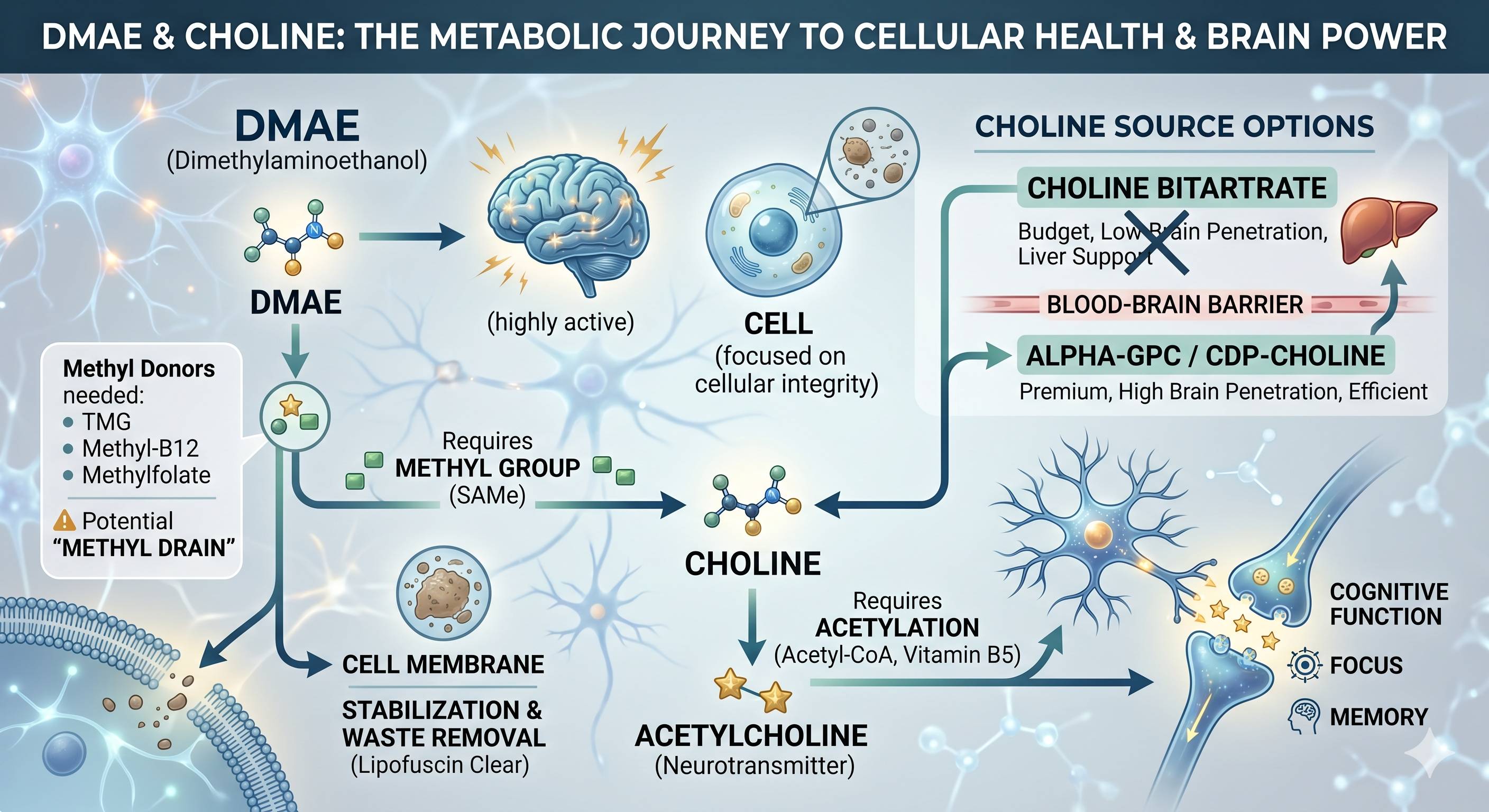
How is DMAE and Methylation connected?Understanding the relationship between DMAE (dimethylaminoethanol) and the methylation cycle is a nuanced dive into nutritional biochemistry. While DMAE is a popular compound for cognitive and cellular health, its interaction with the body’s methyl pool is a critical factor to consider.DMAE and the Methylation ConnectionBiochemically, it is often considered important to support the methylation cycle when supplementing with DMAE. This is due to how the body processes DMAE to create choline.The "Methyl Drain"DMAE is a precursor to choline, but the conversion process requires the addition of methyl groups. Specifically, the body uses SAMe (S-adenosylmethionine), the universal methyl donor, to methylate DMAE into choline.If you supplement with high doses of DMAE without adequate methyl support, you may inadvertently "drain" your methyl pool. This can lead to:
Strategic Co-factorsTo balance this, many researchers suggest pairing DMAE with methyl donors to ensure the cycle remains fluid. Key co-factors include:
How DMAE Supports LongevityDMAE is often categorized as a "longevity" nutrient because of its impact on cellular waste and membrane integrity.1. Reduction of LipofuscinOne of the most cited longevity benefits of DMAE is its ability to reduce lipofuscin (often called "age spots" or "wear-and-tear pigment"). Lipofuscin is a metabolic waste product that accumulates in the heart, brain, and skin cells over time. High levels of lipofuscin can impair cellular function; DMAE helps the body flush these deposits, potentially slowing the cellular aging process.2. Membrane StabilizationDMAE acts as a free radical scavenger specifically within the cell membranes. By protecting the lipid bilayer from oxidative stress, it helps maintain membrane fluidity. Flexible, healthy membranes are essential for efficient nutrient transport into the cell and waste removal out of the cell.3. Acetylcholine PrecursorWhile its primary longevity mechanism is cellular, DMAE’s role as a precursor to acetylcholine supports cognitive longevity. Maintaining healthy levels of this neurotransmitter is vital for focus, memory, and muscle control as the nervous system ages.4. Skin Health and "Lifting"In the context of physical appearance and anti-aging, DMAE is known for its "firming" effect. It is thought to increase the tone of the underlying skin muscles, providing a subtle "lift" and reducing the appearance of fine lines and sagging.Summary: While DMAE offers potent cellular cleaning and membrane protection, it functions best when the body has a robust supply of methyl donors to handle its conversion without taxing the system. Does DMAE efficiently convert to Acetylcholine?The conversion of DMAE (dimethylaminoethanol) into the neurotransmitter acetylcholine is a multi-step biochemical process. Because DMAE is not a direct precursor to acetylcholine, it must first be integrated into the phospholipid metabolism of the cell.To make this conversion efficient, the body requires specific methyl donors and enzymatic co-factors. The Two-Step Conversion Process1. The Methylation Step: DMAE to CholineDMAE is essentially a "dimethylethanolamine." To become choline (trimethylethanolamine), it requires the addition of a third methyl group.
2. The Acetylation Step: Choline to AcetylcholineOnce DMAE has been methylated into choline (or integrated into phosphatidylcholine), it must be acetylated by the enzyme Choline Acetyltransferase (ChAT).
Optimal Co-factors for EfficiencyTo maximize the "brain-boosting" effects of DMAE, the following nutrients are typically used to support the pathway:
The "Choline Sparer" EffectIt is worth noting that DMAE is often more efficient at crossing the blood-brain barrier than standard choline. However, because it "competes" for the same transport systems and enzymes, taking it alongside a high-quality choline source and a B-complex ensures that the body isn't forced to choose between building cell membranes and creating neurotransmitters.What is it better to consume choline or DMAE?Deciding between DMAE and choline depends entirely on whether your priority is systemic health (liver and cell membranes) or cognitive performance (acetylcholine production and focus). While choline is technically a "cheaper" raw material, the "efficiency" changes once you factor in how the body processes each compound.The Efficiency ComparisonEfficiency in this context is usually measured by how well a compound crosses the blood-brain barrier (BBB) and how many metabolic steps are required to reach the final goal: Acetylcholine.1. Choline Bitartrate (The "Budget" Option)
2. DMAE (The "Specialist")
3. Alpha-GPC & CDP-Choline (The "Premium" Options)
Cost-Efficiency Analysis
Which is better?
Summary: Supplementing with DMAE (dimethylaminoethanol) creates a unique biochemical dynamic in the body, particularly regarding cognitive performance and cellular longevity. While DMAE crosses the blood-brain barrier effectively, its conversion into the crucial neurotransmitter acetylcholine requires an additional methyl group, a process that can significantly drain the body's universal methyl donor, SAMe. To prevent this "methyl drain" and avoid issues like elevated homocysteine, it is highly beneficial to pair DMAE with strategic co-factors and methyl donors such as TMG (trimethylglycine) and methylated B-vitamins. Beyond its role in acetylcholine production, DMAE supports longevity through distinct cellular mechanisms that standard choline cannot replicate, specifically by neutralizing free radicals to stabilize cell membranes and flushing out lipofuscin, an age-related cellular waste product. When evaluating whether to replace DMAE with direct choline supplementation for cost and efficiency, the decision hinges on your specific physiological goals. Standard budget options like choline bitartrate are highly cost-effective for general liver health and systemic cell structures, but they suffer from very poor brain penetration. Conversely, premium forms like Alpha-GPC and CDP-Choline are far more efficient for cognitive optimization and memory because they cross the blood-brain barrier effortlessly without taxing the body's methylation cycle. Ultimately, while cheap choline salts cannot replicate DMAE's unique cellular cleaning properties, choosing a premium choline source is a more direct and biochemically efficient path for raw cognitive enhancement, especially if you want to avoid the multi-step metabolic cost associated with converting DMAE.
(https://vitanetonline.com:443/forums/Index.cfm?CFApp=1&Message_ID=6638) Mega-Folinic - Bio-Active Form of Folic Acid 
Date:
January 31, 2007 03:59 PM
(https://vitanetonline.com:443/forums/Index.cfm?CFApp=1&Message_ID=1448) | |||||||||||||||||||||||||||||||||||||||||||||||||||||||||