  |
Beyond Choline: How DMAE Flushes Cellular Waste for Longevity |
|
 Beyond Choline: How DMAE Flushes Cellular Waste for Longevity
|
Darrell Miller | 05/21/26 |
This content is for informational purposes only and is not a substitute for professional medical advice.


Date:
May 21, 2026 03:43 PM
Author: Darrell Miller
(support@vitanetonline.com)
Subject: Beyond Choline: How DMAE Flushes Cellular Waste for Longevity
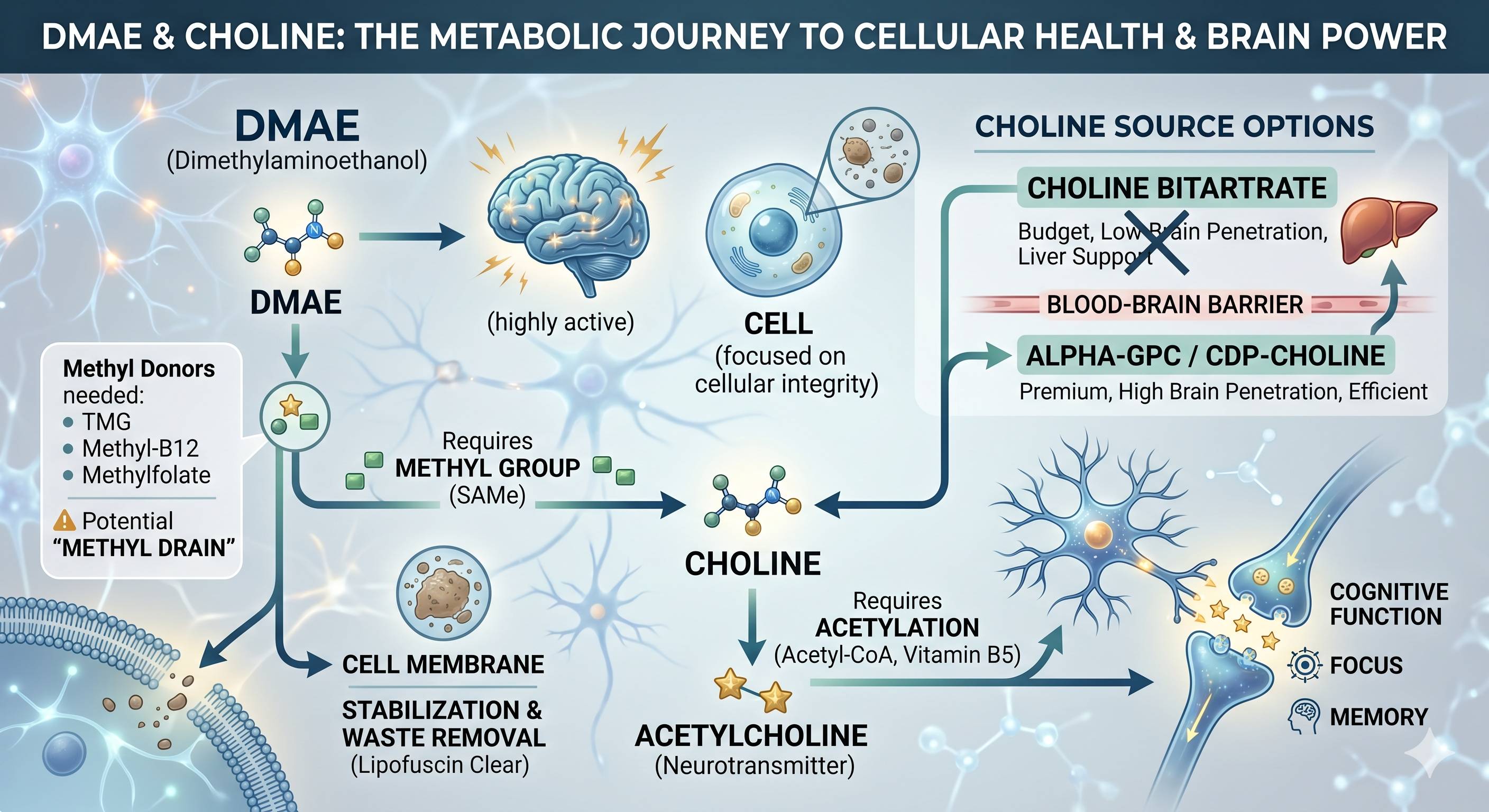
How is DMAE and Methylation connected?
Understanding the relationship between DMAE (dimethylaminoethanol) and the methylation cycle is a nuanced dive into nutritional biochemistry. While DMAE is a popular compound for cognitive and cellular health, its interaction with the body’s methyl pool is a critical factor to consider.DMAE and the Methylation Connection
Biochemically, it is often considered important to support the methylation cycle when supplementing with DMAE. This is due to how the body processes DMAE to create choline.The "Methyl Drain"
DMAE is a precursor to choline, but the conversion process requires the addition of methyl groups. Specifically, the body uses SAMe (S-adenosylmethionine), the universal methyl donor, to methylate DMAE into choline.If you supplement with high doses of DMAE without adequate methyl support, you may inadvertently "drain" your methyl pool. This can lead to:
- Increased Homocysteine: When SAMe donates its methyl group, it eventually turns into homocysteine. Without enough B-vitamins or methyl donors to recycle it, homocysteine levels can rise.
- Reduced Methylation Capacity: A strained methyl pool can affect other vital functions, such as DNA repair, neurotransmitter synthesis, and phase II liver detoxification.
Strategic Co-factors
To balance this, many researchers suggest pairing DMAE with methyl donors to ensure the cycle remains fluid. Key co-factors include:- TMG (Trimethylglycine/Betaine): Directly donates methyl groups to recycle homocysteine.
- Methylated B-Vitamins: Specifically Methylcobalamin (B12) and Methylfolate (5-MTHF).
- Choline: Taking choline alongside DMAE can reduce the "demand" on the body to convert DMAE, sparing methyl groups.
How DMAE Supports Longevity
DMAE is often categorized as a "longevity" nutrient because of its impact on cellular waste and membrane integrity.1. Reduction of Lipofuscin
One of the most cited longevity benefits of DMAE is its ability to reduce lipofuscin (often called "age spots" or "wear-and-tear pigment"). Lipofuscin is a metabolic waste product that accumulates in the heart, brain, and skin cells over time. High levels of lipofuscin can impair cellular function; DMAE helps the body flush these deposits, potentially slowing the cellular aging process.2. Membrane Stabilization
DMAE acts as a free radical scavenger specifically within the cell membranes. By protecting the lipid bilayer from oxidative stress, it helps maintain membrane fluidity. Flexible, healthy membranes are essential for efficient nutrient transport into the cell and waste removal out of the cell.3. Acetylcholine Precursor
While its primary longevity mechanism is cellular, DMAE’s role as a precursor to acetylcholine supports cognitive longevity. Maintaining healthy levels of this neurotransmitter is vital for focus, memory, and muscle control as the nervous system ages.4. Skin Health and "Lifting"
In the context of physical appearance and anti-aging, DMAE is known for its "firming" effect. It is thought to increase the tone of the underlying skin muscles, providing a subtle "lift" and reducing the appearance of fine lines and sagging.Summary: While DMAE offers potent cellular cleaning and membrane protection, it functions best when the body has a robust supply of methyl donors to handle its conversion without taxing the system.
Does DMAE efficiently convert to Acetylcholine?
The conversion of DMAE (dimethylaminoethanol) into the neurotransmitter acetylcholine is a multi-step biochemical process. Because DMAE is not a direct precursor to acetylcholine, it must first be integrated into the phospholipid metabolism of the cell.To make this conversion efficient, the body requires specific methyl donors and enzymatic co-factors.
The Two-Step Conversion Process
1. The Methylation Step: DMAE to Choline
DMAE is essentially a "dimethylethanolamine." To become choline (trimethylethanolamine), it requires the addition of a third methyl group.- SAMe (S-adenosylmethionine): This is the primary methyl donor. Without sufficient SAMe, DMAE cannot efficiently convert to choline.
- The Methylation Support Team: To keep SAMe levels high, the body requires Methyl-B12, Methylfolate, and TMG (Trimethylglycine). These nutrients recycle homocysteine back into methionine, which is then used to create more SAMe.
2. The Acetylation Step: Choline to Acetylcholine
Once DMAE has been methylated into choline (or integrated into phosphatidylcholine), it must be acetylated by the enzyme Choline Acetyltransferase (ChAT).- Acetyl-CoA: This is the "acetyl donor." It is a byproduct of glucose metabolism and the Krebs cycle. Efficient mitochondrial function is necessary to ensure a steady supply of Acetyl-CoA.
- Vitamin B5 (Pantothenic Acid): B5 is the fundamental building block of Coenzyme A (CoA). Since Acetyl-CoA is required for the final "acetyl" attachment, B5 is often considered the most critical co-factor for this specific stage.
Optimal Co-factors for Efficiency
To maximize the "brain-boosting" effects of DMAE, the following nutrients are typically used to support the pathway:| Nutrient | Role in the Pathway |
| Vitamin B5 | Precursor to Acetyl-CoA; facilitates the acetylation of choline. |
| TMG / Betaine | Provides methyl groups to convert DMAE into choline. |
| Alpha-GPC / Citicoline | Provides a direct source of choline, sparing DMAE for other cellular tasks. |
| Magnesium | Required for ATP production, which fuels the enzymatic reactions in the brain. |
The "Choline Sparer" Effect
It is worth noting that DMAE is often more efficient at crossing the blood-brain barrier than standard choline. However, because it "competes" for the same transport systems and enzymes, taking it alongside a high-quality choline source and a B-complex ensures that the body isn't forced to choose between building cell membranes and creating neurotransmitters.What is it better to consume choline or DMAE?
Deciding between DMAE and choline depends entirely on whether your priority is systemic health (liver and cell membranes) or cognitive performance (acetylcholine production and focus). While choline is technically a "cheaper" raw material, the "efficiency" changes once you factor in how the body processes each compound.The Efficiency Comparison
Efficiency in this context is usually measured by how well a compound crosses the blood-brain barrier (BBB) and how many metabolic steps are required to reach the final goal: Acetylcholine.1. Choline Bitartrate (The "Budget" Option)
- Cost: Extremely low.
- Efficiency: High for the liver and general cellular structure, but low for the brain.
- The Issue: Standard choline salts (like bitartrate or citrate) are often broken down by gut bacteria or filtered by the liver before they can reach the brain. They do not cross the BBB effectively, meaning you have to take very high doses to see a cognitive effect, which can lead to digestive upset (the "fishy" odor side effect).
2. DMAE (The "Specialist")
- Cost: Moderate.
- Efficiency: High for membrane stabilization and waste removal, but variable for acetylcholine.
- The Issue: Unlike choline, DMAE crosses the BBB quite easily. However, its efficiency is hampered by the "Methyl Drain" mentioned previously. To become choline (and then acetylcholine), it must be methylated. This makes it a multi-step process that can be "expensive" for your body’s biochemistry if you aren't also supplementing with methyl donors like TMG or Methyl-B12.
3. Alpha-GPC & CDP-Choline (The "Premium" Options)
- Cost: High.
- Efficiency: Maximum.
- The Benefit: These are considered the gold standard for efficiency because they are highly bioavailable and pass the BBB effortlessly. They are direct precursors that "skip" the difficult conversion steps required by DMAE or basic choline salts.
Cost-Efficiency Analysis
| Feature | Choline Bitartrate | DMAE | Alpha-GPC / CDP-Choline |
| Price per Gram | Lowest | Moderate | Highest |
| Brain Penetration | Poor | Good | Excellent |
| Metabolic Cost | Low | High (Requires Methylation) | Minimal |
| Primary Use | Liver health, pregnancy | Anti-aging, waste removal | Focus, memory, power output |
Which is better?
- For pure cost-efficiency: If you are simply looking to meet your daily essential nutrient requirements for liver health and general cellular integrity, Choline Bitartrate is the winner. It provides the most "raw" choline per dollar.
- For cognitive efficiency: If your goal is mental clarity or "nootropic" benefits, Alpha-GPC or CDP-Choline are actually more "efficient" despite the higher price tag. Because they reach the brain so effectively, you can take much smaller doses to achieve a significantly greater effect than a mountain of cheap choline bitartrate.
- The DMAE Exception: You would choose DMAE not as a "cheap choline," but for its unique ability to clear lipofuscin (cellular waste) and stabilize membranes. In this regard, choline cannot replace DMAE.
Summary:
Supplementing with DMAE (dimethylaminoethanol) creates a unique biochemical dynamic in the body, particularly regarding cognitive performance and cellular longevity. While DMAE crosses the blood-brain barrier effectively, its conversion into the crucial neurotransmitter acetylcholine requires an additional methyl group, a process that can significantly drain the body's universal methyl donor, SAMe. To prevent this "methyl drain" and avoid issues like elevated homocysteine, it is highly beneficial to pair DMAE with strategic co-factors and methyl donors such as TMG (trimethylglycine) and methylated B-vitamins. Beyond its role in acetylcholine production, DMAE supports longevity through distinct cellular mechanisms that standard choline cannot replicate, specifically by neutralizing free radicals to stabilize cell membranes and flushing out lipofuscin, an age-related cellular waste product.
When evaluating whether to replace DMAE with direct choline supplementation for cost and efficiency, the decision hinges on your specific physiological goals. Standard budget options like choline bitartrate are highly cost-effective for general liver health and systemic cell structures, but they suffer from very poor brain penetration. Conversely, premium forms like Alpha-GPC and CDP-Choline are far more efficient for cognitive optimization and memory because they cross the blood-brain barrier effortlessly without taxing the body's methylation cycle. Ultimately, while cheap choline salts cannot replicate DMAE's unique cellular cleaning properties, choosing a premium choline source is a more direct and biochemically efficient path for raw cognitive enhancement, especially if you want to avoid the multi-step metabolic cost associated with converting DMAE.