
  |
Beyond Fasting: Can DMAE Restart the Brain's Internal Waste Removal System? |
|
 Can DMAE Help With Cellular Cleanup?
|
Darrell Miller | 05/28/26 |
This content is for informational purposes only and is not a substitute for professional medical advice.


Date:
May 28, 2026 01:38 PM
Author: Darrell Miller
(support@vitanetonline.com)
Subject: Can DMAE Help With Cellular Cleanup?
Can DMAE Help With Cellular Cleanup?
Yes, DMAE - and specifically its highly bioavailable pharmaceutical ester counterpart, centrophenoxine (meclofenoxate) - hits cellular cleanup mechanisms. However, the way it interacts with a stalled system in Parkinson's Disease (PD) is fundamentally different from standard macroautophagy upregulators like fasting or mTOR inhibitors.
Instead of just forcing the cell to create more cleanup vesicles, DMAE addresses the structural and mechanical "traffic jams" that cause the system to stall in the first place.
The Parkinson's Stagnation: An Autophagic Traffic Jam
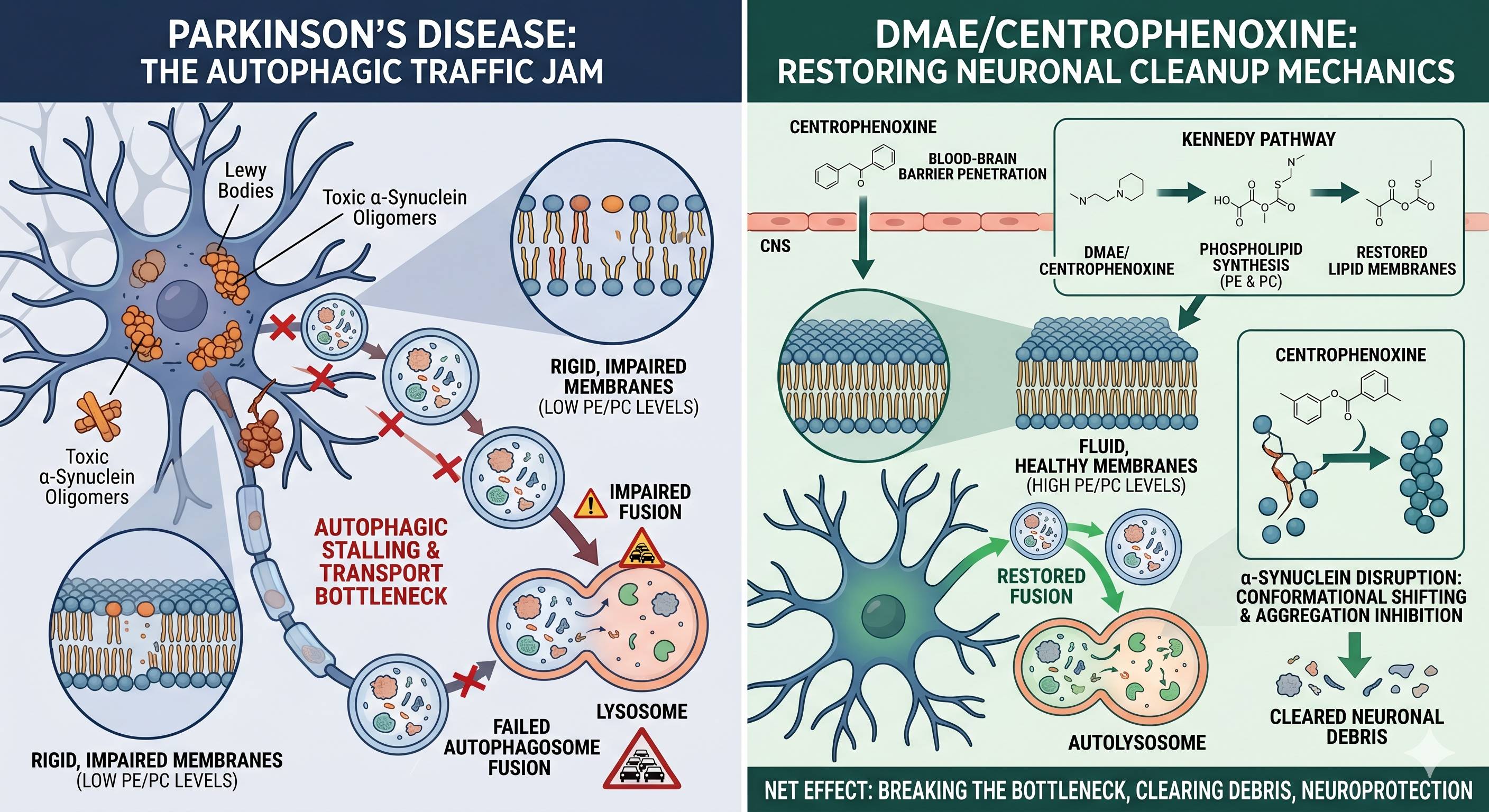
In Parkinson’s pathology, the primary breakdown in cellular quality control occurs within the autophagic-lysosomal pathway. The accumulation of misfolded a-synuclein proteins builds up into toxic aggregates (Lewy bodies). This doesn't just form static waste; it actively paralyzes the cell's transport machinery, halting macroautophagy, chaperone-mediated autophagy (CMA), and mitophagy (the clearing of damaged, radical-producing mitochondria).Here is how a healthy version of this pathway is structured:
As shown above, a healthy cell relies on seamless transport where an autophagosome encapsulates debris and fuses with an acidic lysosome to form an autolysosome for enzymatic destruction. In a stalled Parkinson's state, this crucial fusion and trafficking step is paralyzed.
How DMAE Alters Cleanup Dynamics
DMAE approaches this bottleneck through two precise biochemical mechanisms:1. Re-greasing Vesicle Trafficking Tracks
To build an autophagosome and move it to a lysosome, a neuron requires highly fluid lipid membranes.- Parkinson's progression is closely tied to a critical deficit in key membrane phospholipids, particularly phosphatidylethanolamine (PE) and phosphatidylcholine (PC).
- When PE and PC levels drop, endoplasmic reticulum (ER) stress spikes, and vesicle trafficking grinds to a halt. The autophagosomes simply cannot travel down the microtubules to meet the lysosome.
- DMAE acts as a direct biochemical precursor for the Kennedy pathway, driving the rapid synthesis of these vital phospholipids. By restoring PE and PC to the lipid bilayer, it restores membrane fluidity and essentially "greases the tracks," allowing stalled autophagosomes to resume movement and complete lysosomal fusion.
2. Direct a-Synuclein Disruption
Classically, DMAE is famous in longevity research for dissolving lipofuscin - the cross-linked "wear-and-tear" pigment aggregate that accumulates in aging cells. While lipofuscin is structurally distinct from the amyloid-like sheets of a-synuclein, modern molecular profiling has revealed that DMAE derivatives possess a powerful cross-over effect:- Conformational Shifting: In vitro and animal models show that meclofenoxate directly interacts with the C-terminus of a-synuclein.
- Aggregation Inhibition: By changing the native conformation of the protein, it prevents individual a-synuclein monomers from stacking into the highly toxic, insoluble oligomeric sheets that choke chaperone-mediated autophagy.
Mechanics of Clearance: DMAE vs. Traditional Autophagy Inducers
| Cleanup Agent | Primary Mechanism | Stage of Pathway Targeted | Impact on a-Synuclein |
| DMAE / Centrophenoxine | Phospholipid synthesis & membrane fluidization | Vesicle motility, structural trafficking, and lysosomal fusion | Distorts protein conformation to inhibit aggregate stacking |
| Rapamycin (mTOR Inhibitor) | Enzyme signaling cascade activation | Early initiation (phagophore formation) | Clears soluble forms early by accelerating bulk bulk degradation |
| Trehalose | mTOR-independent TFEB activation | Lysosomal biogenesis and deep acidification | Increases the baseline digestive capacity of the lysosome |
Summary:
In Parkinson’s disease, cellular cleanup stalls because toxic accumulations of misfolded alpha-synuclein proteins physically paralyze the autophagic-lysosomal pathway, creating a mechanical traffic jam that prevents waste-carrying autophagosomes from fusing with digestive lysosomes. Rather than simply triggering the creation of more cleanup vesicles like standard autophagy inducers do, DMAE and its highly bioavailable derivative, centrophenoxine, address this bottleneck structurally. It serves as a direct biochemical precursor to vital membrane phospholipids like phosphatidylcholine, restoring lipid bilayer fluidity and essentially "re-greasing the tracks" so stalled cellular transport machinery can resume normal trafficking and waste elimination.
Beyond restoring membrane dynamics, DMAE compounds actively disrupt protein aggregation by changing the conformation of alpha-synuclein, which prevents individual monomers from stacking into the toxic, insoluble sheets that choke the cell's internal quality control. This action mirrors its well-documented ability to dissolve lipofuscin, the cross-linked "wear-and-tear" aging pigment that accumulates in aging cells. While free-base DMAE struggles to penetrate the central nervous system effectively due to competition with choline transporters, the lipophilic ester centrophenoxine easily crosses the blood-brain barrier, making it the superior vehicle for restoring neural membrane fluidity and clearing out stalled neurodegenerative debris.