  |
The Silent Deficiency Driving Fatty Liver Disease |
|
 Choline: The Liver’s Fat-Export Engine
|
Darrell Miller | 06/24/26 |
This content is for informational purposes only and is not a substitute for professional medical advice.


Date:
June 24, 2026 11:48 AM
Author: Darrell Miller
(support@vitanetonline.com)
Subject: Choline: The Liver’s Fat-Export Engine
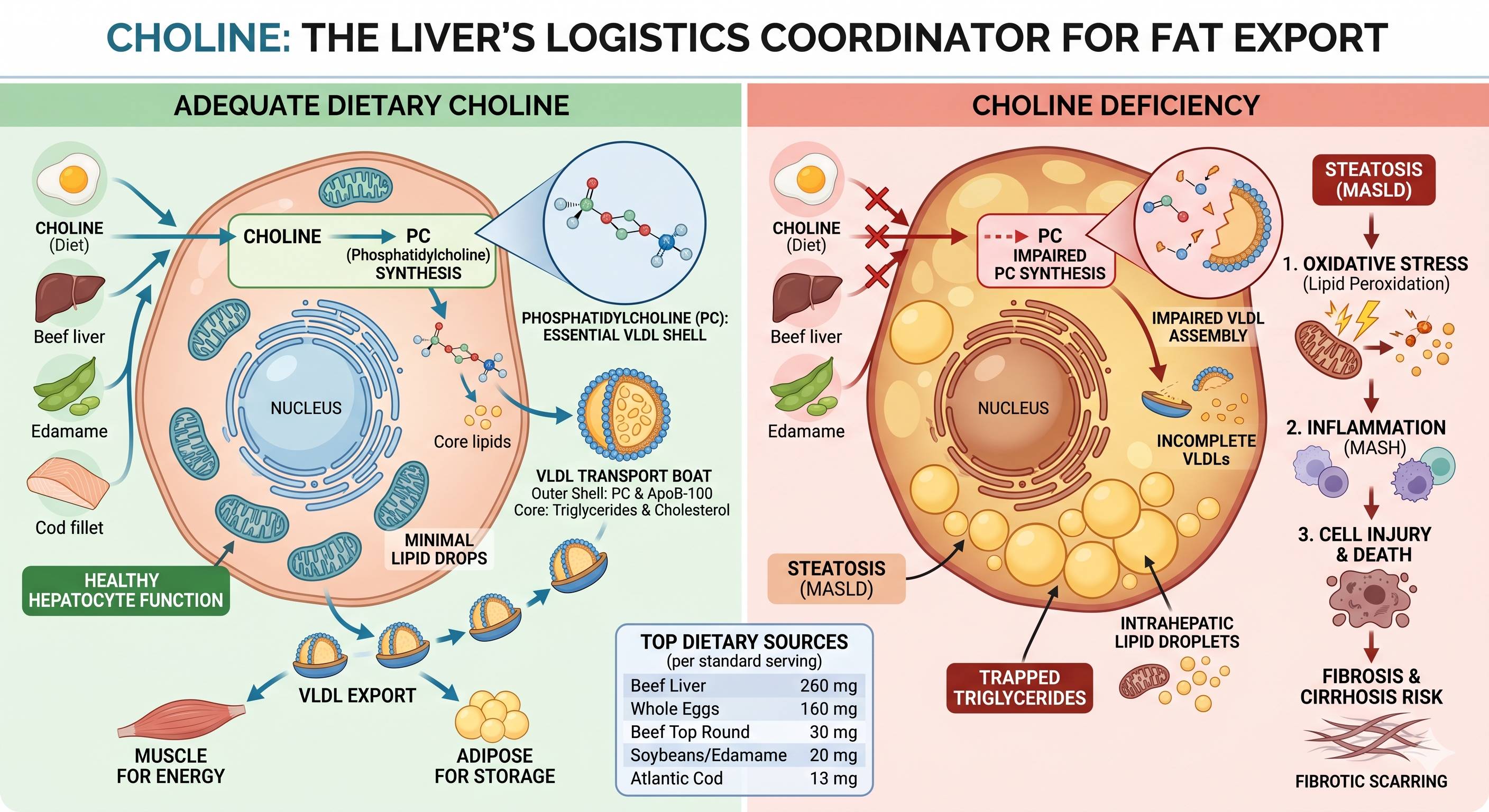
Choline is often grouped with B-vitamins, but it functions as a critical macronutrient that acts like a VIP logistics coordinator for your liver. While the body can produce a small amount of choline endogenously (on its own), we rely heavily on dietary intake to meet daily metabolic demands.
Without sufficient choline, the liver's ability to process and export fats grinds to a halt.
The Liver’s Fat-Export Mechanism
The primary reason the liver requires choline comes down to a specific molecule: phosphatidylcholine (PC).When you eat fats or liberate stored fatty acids, your liver processes them into triglycerides. To move these triglycerides out of the liver and deliver them to muscle or adipose (fat) tissue for energy or storage, the liver has to package them into transport vehicles called VLDL (Very Low-Density Lipoproteins).
Phosphatidylcholine forms the essential outer shell of these VLDL transport "boats." If you don't have enough choline, your liver cannot manufacture this outer shell, meaning the boats cannot be built, and fat cannot leave the liver.
What Happens When Choline is Deficient?
When dietary choline drops below critical levels, a highly predictable cascade of liver dysfunction occurs:- Fat Accumulation (Steatosis): Because triglycerides cannot be packaged into VLDL, they begin to back up inside the liver cells (hepatocytes). This direct trapping of fat leads rapidly to MASLD (Metabolic Dysfunction-Associated Steatotic Liver Disease, historically known as NAFLD or non-alcoholic fatty liver disease).
- Mitochondrial Dysfunction & Oxidative Stress: As fat accumulates, it overwhelms the cells' mitochondria (the energy producers). This structural backup causes the mitochondria to leak reactive oxygen species, leading to lipid peroxidation - essentially causing the trapped fat to oxidize and damage surrounding cell structures.
- Cellular Injury and Inflammation: The combination of trapped fat and oxidative stress triggers an inflammatory response. This stage, known as MASH (Metabolic Dysfunction-Associated Steatohepatitis), causes liver cell death and pushes liver enzymes like ALT and AST to spill into the bloodstream.
- Fibrosis and Long-Term Damage: If the deficiency persists, the liver attempts to heal its wounded tissue by depositing collagen fibers. Over time, this scarring (fibrosis) can progress to cirrhosis, permanently impairing liver function.
Dietary Benchmarks & Sources
To prevent fat accumulation and support proper VLDL export, the Food and Nutrition Board establishes specific Adequate Intake (AI) targets, though optimal metabolic and athletic performance may require a more robust baseline.| Food Source | Choline Content (per standard serving) | Why It Helps |
| Beef Liver (3 oz cooked) | ~350 mg | The most concentrated source; provides immediate raw material for PC synthesis. |
| Whole Eggs (1 large) | ~147 mg | High-bioavailability choline concentrated entirely within the yolk lecithin. |
| Beef Top Round (3 oz cooked) | ~117 mg | Provides structural choline alongside high-quality protein. |
| Soybeans / Roasted Edamame (1/2 cup) | ~107 mg | Excellent plant-based source of phosphatidylcholine. |
| Atlantic Cod (3 oz cooked) | ~71 mg | Lean source that delivers choline alongside anti-inflammatory omega-3s. |
Summary:
Choline acts as a critical logistics coordinator for liver health, serving as a non-negotiable raw material for exporting fat out of the organ. Specifically, the liver relies on choline to produce phosphatidylcholine, a molecule that forms the essential outer shell of Very Low-Density Lipoproteins (VLDL). Think of VLDLs as transport boats designed to safely carry triglycerides out of the liver and deliver them to the rest of the body for energy or storage. Without an adequate dietary supply of choline, the liver simply cannot build these outer shells, causing the entire transport system to grind to a halt and leaving processed fats stranded inside liver cells.
When this export mechanism stalls, the stranded fat quickly triggers a highly predictable cascade of liver dysfunction. This buildup leads directly to fat accumulation - historically known as fatty liver disease and now classified as MASLD - which quickly overwhelms the cellular mitochondria. The resulting oxidative stress and cellular injury spark chronic inflammation (MASH), causing liver cells to die and potentially leading to permanent scarring or fibrosis over time. Furthermore, a severe shortage of dietary choline starves the body's methylation cycle, forcing it to deplete vital SAMe pools in a desperate, structurally taxing attempt to manufacture its own phosphatidylcholine.