|
Search Term: " Parkinsons "
Can DMAE Help With Cellular Cleanup?   
Date:
May 28, 2026 01:38 PM
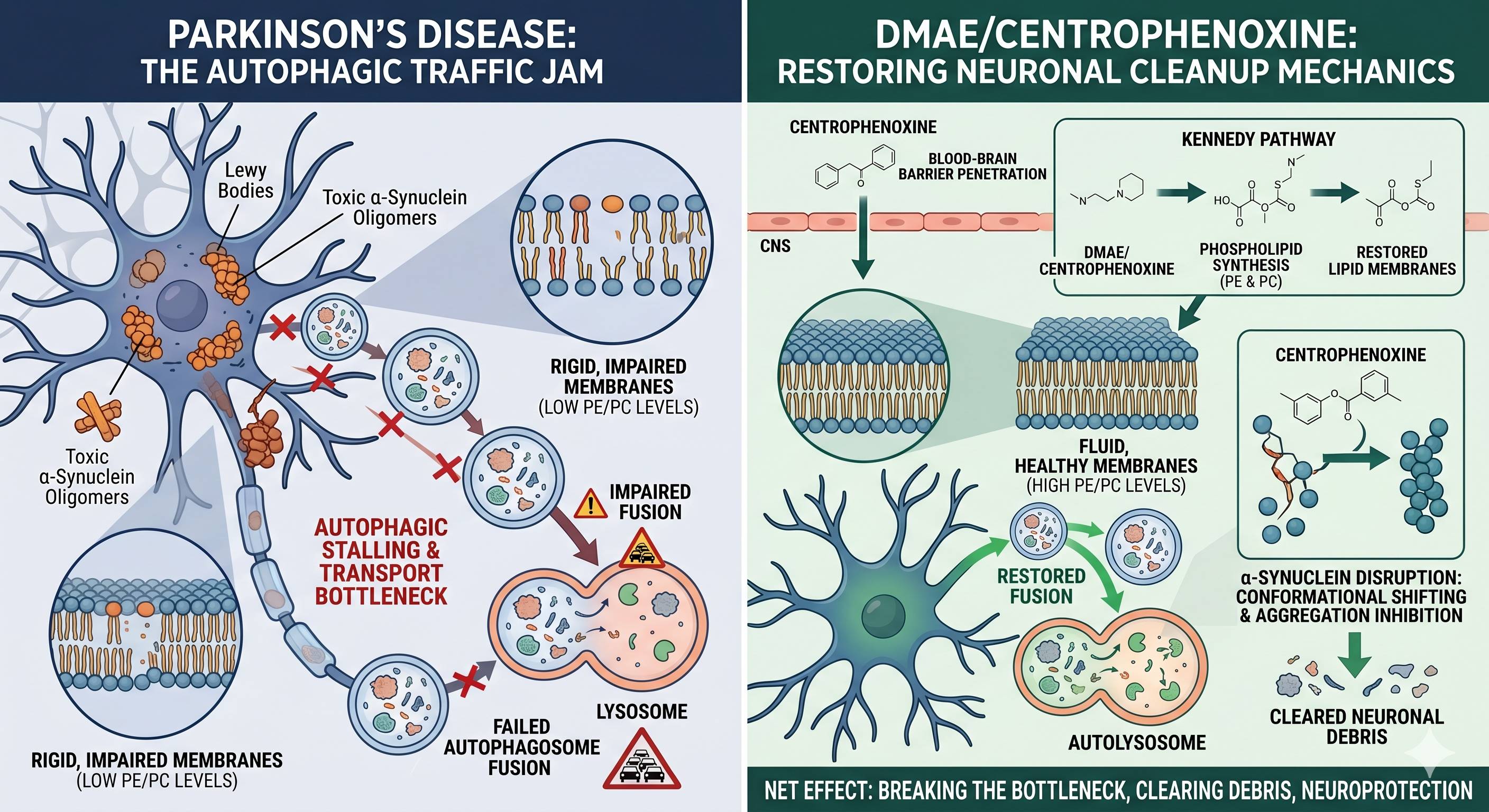
Yes, DMAE - and specifically its highly bioavailable pharmaceutical ester counterpart, centrophenoxine (meclofenoxate) - hits cellular cleanup mechanisms. However, the way it interacts with a stalled system in Parkinson's Disease (PD) is fundamentally different from standard macroautophagy upregulators like fasting or mTOR inhibitors. Instead of just forcing the cell to create more cleanup vesicles, DMAE addresses the structural and mechanical "traffic jams" that cause the system to stall in the first place. The Parkinson's Stagnation: An Autophagic Traffic JamIn Parkinson’s pathology, the primary breakdown in cellular quality control occurs within the autophagic-lysosomal pathway. The accumulation of misfolded a-synuclein proteins builds up into toxic aggregates (Lewy bodies). This doesn't just form static waste; it actively paralyzes the cell's transport machinery, halting macroautophagy, chaperone-mediated autophagy (CMA), and mitophagy (the clearing of damaged, radical-producing mitochondria).Here is how a healthy version of this pathway is structured: As shown above, a healthy cell relies on seamless transport where an autophagosome encapsulates debris and fuses with an acidic lysosome to form an autolysosome for enzymatic destruction. In a stalled Parkinson's state, this crucial fusion and trafficking step is paralyzed. How DMAE Alters Cleanup DynamicsDMAE approaches this bottleneck through two precise biochemical mechanisms:1. Re-greasing Vesicle Trafficking TracksTo build an autophagosome and move it to a lysosome, a neuron requires highly fluid lipid membranes.
2. Direct a-Synuclein DisruptionClassically, DMAE is famous in longevity research for dissolving lipofuscin - the cross-linked "wear-and-tear" pigment aggregate that accumulates in aging cells. While lipofuscin is structurally distinct from the amyloid-like sheets of a-synuclein, modern molecular profiling has revealed that DMAE derivatives possess a powerful cross-over effect:
Mechanics of Clearance: DMAE vs. Traditional Autophagy Inducers
Summary: In Parkinson’s disease, cellular cleanup stalls because toxic accumulations of misfolded alpha-synuclein proteins physically paralyze the autophagic-lysosomal pathway, creating a mechanical traffic jam that prevents waste-carrying autophagosomes from fusing with digestive lysosomes. Rather than simply triggering the creation of more cleanup vesicles like standard autophagy inducers do, DMAE and its highly bioavailable derivative, centrophenoxine, address this bottleneck structurally. It serves as a direct biochemical precursor to vital membrane phospholipids like phosphatidylcholine, restoring lipid bilayer fluidity and essentially "re-greasing the tracks" so stalled cellular transport machinery can resume normal trafficking and waste elimination. Beyond restoring membrane dynamics, DMAE compounds actively disrupt protein aggregation by changing the conformation of alpha-synuclein, which prevents individual monomers from stacking into the toxic, insoluble sheets that choke the cell's internal quality control. This action mirrors its well-documented ability to dissolve lipofuscin, the cross-linked "wear-and-tear" aging pigment that accumulates in aging cells. While free-base DMAE struggles to penetrate the central nervous system effectively due to competition with choline transporters, the lipophilic ester centrophenoxine easily crosses the blood-brain barrier, making it the superior vehicle for restoring neural membrane fluidity and clearing out stalled neurodegenerative debris.
(https://vitanetonline.com:443/forums/Index.cfm?CFApp=1&Message_ID=6641) Watch ANOTHER Man with Severe Parkinson’s Take Cannabis Oil to Settle his Tremors 
Date:
March 16, 2017 11:14 AM
In considering whether cannabinoids are a suitable therapy for Parkinson's symptoms, the potential benefits must be weighed against the possible side effects. Used in moderation, cannabinoids appear to be relatively well tolerated. Even so, a review of clinical trials involving cannabinoids showed that nearly seven percent of participants discontinued them due to issues such as nausea, dizziness, weakness, mood and behavioral changes, hallucinations and impairment of cognitive (memory/thinking) abilities. [video mp4="//www.healthnutnews.com/watch-another-man-severe-Parkinsons-take-cannabis-oil-settle-tremors/"] Key Takeaways:
"His used just a single drop and his hands afterwards were rock steady and the Dyskinesia left."
(https://vitanetonline.com:443/forums/Index.cfm?CFApp=1&Message_ID=4173) Did you know that cinnamon can boost intelligence? 
Date:
November 01, 2016 06:09 PM
cinnamon has a flavor that you either love or you hate. If you happen to be someone that enjoys the taste, you're in luck! did you know that cinnamon consumption may work to boost your intelligence? The next time someone questions how smart you are, pull out the cinnamon and thank them for noticing! Key Takeaways:
"Scientists at Rush University Medical Center in Chicago found that increased ingestion of cinnamon significantly improved the memory of "poor learning" mice." Reference: //www.naturalnews.com/055813_cinnamon_intelligence_Parkinsons_disease.html
(https://vitanetonline.com:443/forums/Index.cfm?CFApp=1&Message_ID=3369) | ||||||||||||||||||||||||||||||||||||||||