- *MSRP:
$12.79- Our Price:
- $10.23
- Subscribe and Save:
- $7.81ea.
- Buy: at $10.23


Reviewed against primary clinical literature from the National Institutes of Health (NIH) and the National Center for Biotechnology Information (NCBI).
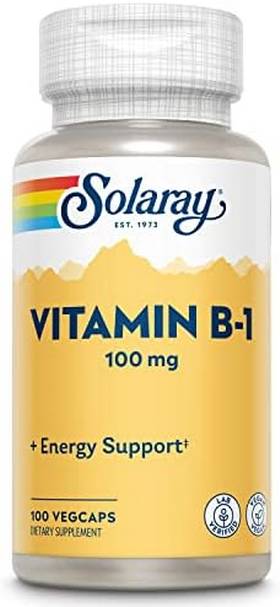
Feeling constantly sluggish or mentally drained? Your body might be struggling to convert everyday calories into usable cellular fuel. Solaray B1 - 100mg delivers a potent, bioavailable dose of Thiamine Mononitrate designed to ignite your cellular engine, nourish sensitive peripheral nerves, and promote cardiovascular vitality in one gentle, daily vegetable capsule.
✓ 100 mg High PotencySupplies 8,333% of your Daily Value to replenish low stores rapidly.
Resists room moisture to maintain fresh, full-strength biological activity.
✓ Whole Food SynergistsEnhanced with unpolished brown rice concentrates and soothing aloe vera.
✓ 100% Vegan & Lab-VerifiedPlant-based VegCap tested for purity, heavy metals, and potency.
To understand why Vitamin B1 (Thiamine) is so vital, think of your body as a high-performance vehicle:
Carbohydrates, starches, and sugars are like gasoline sitting in your fuel tank. But fuel cannot move a car without a spark. In human biochemistry, Vitamin B1 transforms into an active coenzyme called thiamin diphosphate (TDP). TDP acts as the spark plug inside your cell mitochondria, breaking down glucose to produce adenosine triphosphate (ATP)—the universal energy currency that keeps your heart pumping, brain thinking, and muscles moving.
Your nerves resemble household electrical cords. If the protective rubber coating on a cord wears off, the electricity short-circuits. Thiamine is directly responsible for synthesizing the myelin sheath—the fatty insulation wrapped around nerve fibers. Adequate thiamine prevents erratic signals, tingling, numbness, and burning sensations in the hands and feet.
Your brain uses roughly 20% of your total glucose despite accounting for only 2% of your body weight. Thiamine helps produce acetylcholine, a neurotransmitter critical for memory recall, focus, and steady mood control. When B1 runs low, cognitive fog, unexplained irritability, and memory lapses often follow.
The standard Recommended Dietary Allowance (RDA) for Vitamin B1 is only 1.1 mg to 1.2 mg per day. You might wonder: Why does Solaray B1 offer 100mg—or 8,333% of the Daily Value?
According to the National Institutes of Health (NIH) Office of Dietary Supplements, your small intestine absorbs low amounts of dietary thiamine through protein channels (active transport). However, these channels become saturated at small doses (around 5 mg).
When you take a therapeutic 100mg dose, your digestive tract switches to passive diffusion. The concentration gradient allows thiamine molecules to pass directly through intestinal cell walls into your bloodstream. Because Vitamin B1 is strictly water-soluble, your body uses whatever it requires for tissue saturation and enzyme reactivation, safely releasing any unneeded excess through the urine.
Solaray formulates this supplement with Thiamine Mononitrate. Unlike Thiamine HCl—which is highly hygroscopic and readily pulls moisture from room air, leading to degradation inside the bottle—the mononitrate salt is non-hygroscopic and thermally stable. This ensures every capsule delivers 100% of the labeled 100mg potency right up to its expiration date.
Because human tissue stores less than 30 mg of thiamine at any given time (mainly in the liver), your body exhausts its internal supply within 2 to 3 weeks without continuous intake. Modern refined foods, prescription drugs, and lifestyle stressors often accelerate thiamine depletion.
Metabolizing white flour, white rice, pasta, and sugary snacks burns up massive quantities of thiamine cofactors without putting any back in.
Alcohol damages intestinal thiamine transporters, impairs liver activation of TDP, and speeds up kidney excretion.
Common diuretic medications (such as furosemide) flush excess water through the kidneys, carrying large amounts of water-soluble B1 out with it.
Individuals with Crohn's disease, celiac disease, or prior gastric bypass surgery have reduced intestinal surface area for nutrient absorption.
Early Warning Signs of Low Thiamine: General morning fatigue, unexplained muscle soreness, loss of appetite, brain fog, and "pins-and-needles" sensations in fingers and toes (StatPearls, NCBI Bookshelf).
Solaray B1 - 100mg (100 VegCaps) | UPC: 076280043259 | Item Catalog: #4325
Supplement Facts Serving Size: 1 VegCap Servings Per Container: 100| Amount Per Serving | % Daily Value |
|---|---|
| Thiamine (as Thiamine Mononitrate) (B-1) | 100 mg (8,333% DV) |
Allergen Declaration: Free from gluten, soy, dairy, artificial colors, artificial flavors, and preservatives. Non-GMO and strictly vegan.
Directions: As a dietary supplement, take 1 VegCap daily with a meal or a large glass of water, or use as directed by your licensed healthcare provider. Store tightly sealed in a cool, dry place away from direct sunlight.
The Food and Nutrition Board of the National Academies has not established a Tolerable Upper Intake Level (UL) for Vitamin B1. Even at high doses over 100 mg daily, oral thiamine exhibits no known systemic toxicity because the kidneys readily clear excess amounts.
Standard high-dose B vitamins can occasionally cause stomach distress on an empty stomach. Solaray infuses each VegCap with brown rice concentrate and aloe vera gel to cushion digestion and support gentle absorption.
Clear answers to the most common questions regarding Vitamin B1 supplementation.
Vitamin B1 100mg is primarily used to restore healthy cellular energy production, reinforce the peripheral nervous system, and protect cardiovascular function. It assists your body in converting dietary carbohydrates into usable ATP energy and supports the nerve insulation needed to prevent numbness and tingling in your extremities.
Yes, it is remarkably safe. Because Vitamin B1 is completely water-soluble, it does not accumulate in your fatty tissues or organs. The standard RDA (1.2 mg) represents the bare minimum to prevent clinical diseases like beriberi. A 100mg dosage saturates body stores via passive diffusion, ensuring adequate tissue levels even for individuals taking medications, consuming alcohol, or experiencing metabolic stress. The NIH reports no toxic upper intake limit for oral thiamine.
The difference lies in shelf stability and moisture resistance. Thiamine Hydrochloride (HCl) is hygroscopic, meaning it easily pulls moisture from room air and breaks down when stored. Thiamine Mononitrate does not attract water, making it significantly more stable and ensuring your capsules retain full potency throughout their shelf life.
Early deficiency symptoms include unexplained fatigue, irritability, brain fog, reduced short-term memory, and mild muscle weakness. If left uncorrected, more severe deficiency can progress to peripheral neuropathy (burning or tingling sensations in the feet and hands), heart rhythm irregularities, or clinical beriberi.
It is best taken in the morning or early afternoon with a meal and a glass of water. Because Vitamin B1 directly participates in converting food into physical energy, taking it earlier in the day supports alert daytime energy and avoids interference with your natural sleep cycle.
Certain medications can deplete your thiamine levels, particularly loop diuretics (such as furosemide), fluorouracil (a chemotherapy agent), and chronic antacid use. Supplementing with 100mg of B1 can help restore depleted levels, but always consult your physician or pharmacist before introducing any new supplement alongside prescription drugs.