- *MSRP:
$7.29- Our Price:
- $5.83
- Subscribe and Save:
- $4.38ea.
- Buy: at $5.83


Essential daily nutritional support for healthy blood clotting, calcium balance, and strong bone density.
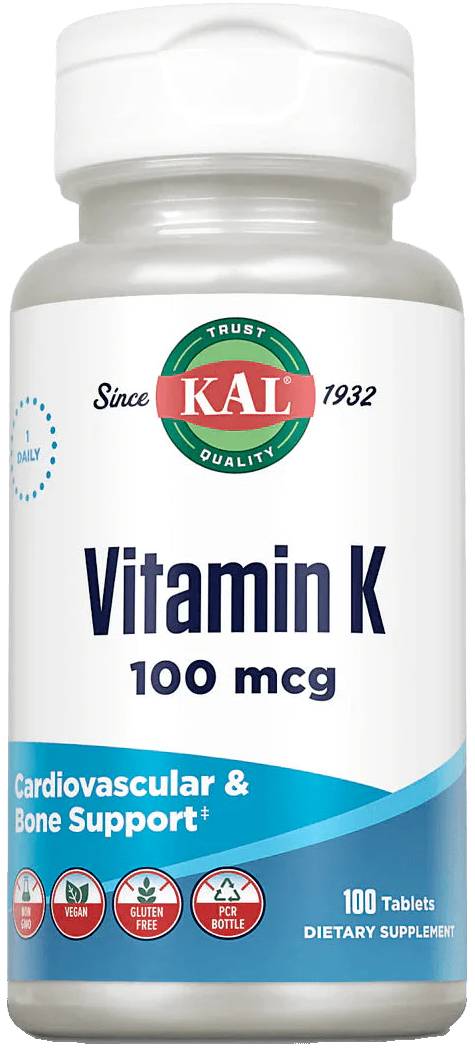
Vitamin K is a fundamental fat-soluble nutrient that your body relies on every single day, yet it remains one of the most underappreciated vitamins in modern diets. KAL Vitamin K 100mcg supplies a balanced, highly bioavailable 100 microgram serving of pure phylloquinone (Vitamin K-1)—the plant-derived form of Vitamin K found in nutrient-rich leafy greens. Designed with KAL’s laboratory-tested Rapid-Solv® disintegration technology, each small, easy-to-swallow tablet breaks down within 30 minutes to ensure quick absorption and reliable cellular delivery.
To understand why you need Vitamin K, think of it as your body’s molecular traffic controller and emergency repair switch. While vitamins like C and D get most of the spotlight, Vitamin K performs two lifesaving biological jobs that nothing else can replace:
When you get a paper cut or scrape your knee, your body needs to stop the bleeding quickly. To do this, your liver produces special proteins known as clotting factors (most notably prothrombin). Vitamin K acts as the biological activator for these proteins. Without sufficient Vitamin K, your clotting factors remain inactive, leaving your body unable to form natural seals to stop everyday bleeding.
Calcium gives your skeleton its strength, but calcium cannot find its way into your bones on its own. Your osteoblasts (bone-building cells) make a specialized protein called osteocalcin. Vitamin K binds to osteocalcin and switches it "on." Once activated, osteocalcin pulls free calcium out of your bloodstream and locks it directly into your bone matrix, keeping bones dense, durable, and resilient against fractures.
Many shoppers ask whether they need Vitamin K1 or Vitamin K2. While both belong to the Vitamin K family, they come from different sources and serve distinct primary roles:
| Nutrient Property | Vitamin K1 (Phylloquinone) — In This KAL Formula | Vitamin K2 (Menaquinones / MK-4, MK-7) |
|---|---|---|
| Natural Dietary Sources | Kale, spinach, collards, broccoli, Brussels sprouts, plant oils | Fermented soybeans (natto), aged cheeses, curd, animal organ meats |
| Primary Action in Body | Concentrates heavily in liver tissues; rapidly activates clotting cascades & supports bone proteins | Circulates longer in bloodstream; activates osteocalcin and matrix Gla protein (MGP) in arteries |
| Dietary Intake Prevalence | Accounts for approximately 75% to 90% of total dietary vitamin K intake in Americans | Synthesized by gut microflora in modest amounts; limited in standard western diets |
| Best For | Replenishing natural dietary baselines, supporting normal coagulation factors, and foundational bone health | Targeted arterial calcification defense and prolonged systemic circulation |
KAL Vitamin K delivers pure phylloquinone at 100 mcg per tablet, matching the primary natural form consumed in traditional, wholesome green plant diets.
Vitamin K has been subject to decades of clinical investigation. Below is an overview of what peer-reviewed nutritional science and health institutions confirm regarding its physiological functions:
Vitamin K is required as an enzyme cofactor for gamma-glutamyl carboxylase. This enzyme transforms inactive precursor proteins into functioning blood clotting agents: Factor II (prothrombin), Factor VII, Factor IX, and Factor X, as well as proteins C and S. Without adequate daily intake, blood takes significantly longer to clot, increasing vulnerability to prolonged bleeding from minor abrasions or surgical procedures.
Epidemiological studies, including long-term data from the Framingham Heart Study and the Nurses' Health Study, have revealed that individuals with higher dietary Vitamin K intakes exhibit greater bone mineral density and significantly reduced risk of hip fractures. When osteocalcin is adequately carboxylated by Vitamin K, it forms strong crystalline bonds with bone hydroxyapatite, helping guard against age-related bone thinning and osteopenia.
Beyond the skeleton, Vitamin K activates Matrix Gla Protein (MGP), a potent mineral-binding protein located in arterial vessel walls. By activating MGP, Vitamin K prevents free calcium from sticking to arterial linings, supporting vascular elasticity, normal circulation, and long-term cardiovascular integrity.
VitaNet® is committed to total ingredient transparency. Below is the complete nutritional label and excipient profile for KAL Vitamin K 100mcg tablets:
Serving Size: 1 Tablet
Servings Per Container: 100
| Amount Per Serving | % Daily Value |
|---|---|
| Vitamin K (as Phylloquinone) 100 mcg | 83% |
* Percent Daily Values are based on a 2,000 calorie diet.
Active Ingredient: Vitamin K (as Phylloquinone) — 100 mcg per serving.
Other Ingredients: Cellulose, Stearic Acid, Silica, and Magnesium Stearate.
✓ Vegetarian Formulation | ✓ Rapid-Solv® Disintegration Tested | ✓ Manufactured in a cGMP Facility | ✓ Free of Artificial Colors, Yeast, and Preservatives
Because Vitamin K is a fat-soluble vitamin, the way you take your daily tablet directly impacts how much nutrient reaches your cells:
Notice for Patients on Blood Thinners: Vitamin K directly opposes the pharmacological action of oral anticoagulant medications such as warfarin (Coumadin®). If you take prescription blood thinners or anti-platelet therapy, sudden changes in your daily Vitamin K intake can alter your INR (International Normalized Ratio) and interfere with your clotting time. Do not take this supplement or alter your dietary Vitamin K intake without direct consultation and monitoring by your prescribing physician.
KAL Vitamin K 100 mcg provides nutritional support for normal, healthy blood clotting and bone strength. It supplies phylloquinone (Vitamin K-1), which your body uses to produce prothrombin for wound healing and to activate osteocalcin, the primary protein responsible for locking calcium into bone tissue.
Vitamin K1 (phylloquinone) is naturally found in leafy green vegetables and is primarily directed toward the liver to support proper blood coagulation and overall protein synthesis. Vitamin K2 (menaquinones) is found in fermented foods and animal products and circulates longer in peripheral blood vessels, where it assists in arterial flexibility and bone calcium distribution. Both forms are beneficial, with K1 being the body’s principal dietary source.
The Food and Drug Administration (FDA) Daily Value for Vitamin K is set at 120 mcg for adults, while the National Academy of Medicine establishes an Adequate Intake (AI) of 90 mcg daily for women and 120 mcg daily for men. A 100 mcg dose is calibrated to bridge common dietary gaps from everyday meals without causing unnecessary excess, providing safe, balanced daily support.
Rapid-Solv® is KAL’s specialized tablet technology engineered to guarantee that the tablet disintegrates completely within 30 minutes, adhering to United States Pharmacopeia (USP) testing standards. This rapid breakdown ensures that your digestive system can quickly release and absorb the phylloquinone.
No, not without express approval and ongoing monitoring from your physician. Prescription blood-thinning medications like warfarin (Coumadin) function specifically by inhibiting Vitamin K recycling in the liver. Taking supplemental Vitamin K can counteract your medication and increase the risk of dangerous blood clots.
Vitamin K can be taken at any time of day that fits your routine, but it should always be taken alongside a meal or snack containing healthy fats (such as avocado, nuts, dairy, or olive oil). Because Vitamin K is fat-soluble, dietary fat is required for your intestinal walls to absorb it effectively.
Natural Vitamin K1 (phylloquinone) has an exceptional safety profile. The National Academy of Medicine’s Food and Nutrition Board has not established a Tolerable Upper Intake Level (UL) for Vitamin K because clinical studies have found no adverse toxic effects even at high supplemental doses in healthy individuals. However, exceeding suggested dosage without medical supervision is never recommended.
FDA Disclaimer: The statements made regarding these products have not been evaluated by the Food and Drug Administration. This product is not intended to diagnose, treat, cure, or prevent any disease.
About VitaNet® LLC: Family-owned and operating online since 1995, VitaNet® delivers fresh, manufacturer-sealed vitamins backed by our 100% money-back guarantee and dedicated customer care.