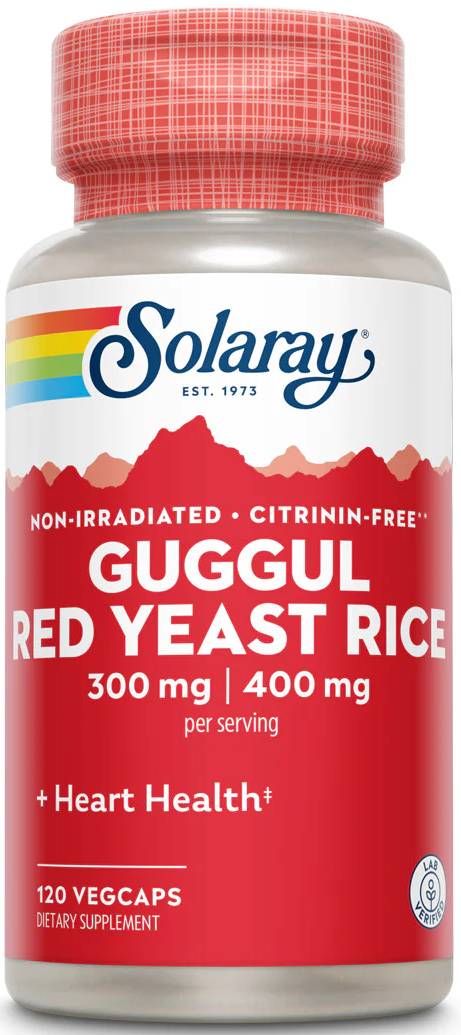
Solaray Red Yeast Rice 600 mg (120 Vegetarian Capsules)
A time-tested, laboratory-verified botanical formula designed to support healthy cholesterol levels already within the normal range. Non-irradiated, vegan, and rigorously screened to be completely citrinin-free.
Standardized Potency600 mg Pure Extract per capsule
Purity GuaranteedHPLC Citrinin-Free Tested
Supply Size120 VegCaps (60-Day Supply)
Formulation100% Vegan & Non-Irradiated
What Is Red Yeast Rice & How Does It Work in the Body?
Red Yeast Rice (traditionally known in Asian herbalism as Hong Qu) is produced by culturing and fermenting red yeast (Monascus purpureus) over non-GMO rice. While it has been utilized in Asian cuisine and traditional wellness practices for over a thousand years, modern biochemical research has uncovered exactly why it holds such a respected reputation for cardiovascular care.
The "Liver Factory" Metaphor: Understanding Endogenous Cholesterol
A common misconception is that all blood cholesterol comes from the foods we eat. In reality, dietary intake accounts for only about 20% to 25% of circulating cholesterol. The remaining 75% to 80% is manufactured right inside your liver through an internal assembly line called the mevalonate pathway.
The primary "switch" or foreman overseeing this assembly line is an enzyme called HMG-CoA reductase. Red yeast rice naturally produces a family of botanical compounds called monacolins, along with healthy unsaturated fatty acids, phytosterols, and isoflavones. These natural components gently moderate the activity of HMG-CoA reductase.
The Dual-Action Cardiovascular Benefit:
Slows Excess Production: By naturally inhibiting HMG-CoA reductase, it curtails the liver from overproducing endogenous cholesterol.
Accelerates Blood Clearance: When the liver senses less internal cholesterol being made, it activates "LDL receptors" on its surface. These receptors act like microscopic catchers' mitts, pulling circulating LDL particles out of your bloodstream to keep blood vessels clear.
Protects Endothelial Lining: Plant sterols and natural fermentation metabolites provide antioxidant support, helping defend the smooth arterial wall lining from oxidative stress.
Clinical Evidence & Peer-Reviewed Research
Unlike many trending supplements that lack rigorous human testing, the botanical compounds found in Monascus purpureus fermentation have been evaluated in numerous double-blind, placebo-controlled clinical trials published in leading medical and nutritional journals.
Clinical Trial & Journal
Participant Profile
Dosage & Duration
Documented Clinical Outcomes
Heber et al. (1999) American Journal of Clinical Nutrition
83 adults with elevated total & LDL cholesterol
2.4 g daily (four 600 mg capsules) for 12 weeks
Total cholesterol decreased by 21%, LDL ("bad") cholesterol decreased by 31%, and triglycerides fell by 34% compared to placebo.
Becker et al. (2009) Annals of Internal Medicine
62 patients with dyslipidemia unable to tolerate prescription statins due to myalgia
1,800 mg twice daily alongside lifestyle change for 24 weeks
LDL decreased significantly by 43 mg/dL at week 12 and 35 mg/dL at week 24 without muscle pain relapse or CPK enzyme elevation.
Lu et al. / CCSPS (2008) American Journal of Cardiology
4,870 patients evaluated across a large multicenter secondary-prevention trial
Standardized extract across average 4.5-year follow-up
Produced a 45% relative risk reduction in primary cardiovascular events and a 33% reduction in total all-cause mortality.
Scientific Takeaway: Clinical researchers note that the diverse array of naturally occurring compounds in fermented red yeast rice works synergistically. This matrix allows it to offer noticeable lipid support even at dosages significantly lower than isolated pharmaceutical equivalents.
The Solaray Quality Advantage: Why "Citrinin-Free" Matters
When purchasing red yeast rice, purity is just as critical as potency. During improper, uncontrolled, or cheap yeast fermentation, Monascus purpureus can generate an unwanted secondary chemical byproduct called citrinin.
According to extensive safety evaluations by the European Food Safety Authority (EFSA) and the U.S. National Institutes of Health (NIH), citrinin is a nephrotoxic mycotoxin—meaning that over time, it can cause cellular stress in your kidneys. Independent tests have revealed that bargain or unverified brands often contain detectable traces of this toxin.
Solaray guarantees that every single production lot of their Red Yeast Rice undergoes strict High-Performance Liquid Chromatography (HPLC) testing. This pharmaceutical-grade testing protocol confirms that citrinin is completely undetectable within stringent laboratory thresholds, safeguarding your kidneys.
✓ 100% Non-Irradiated Botanical
Never treated with ionizing gamma irradiation, ensuring the delicate natural phytochemicals, fatty acids, and active enzymes remain intact and unadulterated.
✓ Clean Vegetarian Delivery
Encapsulated in plant-derived cellulose capsules with zero bovine or porcine gelatin, no artificial colorings, no animal fillers, and no synthetic additives.
The CoQ10 Connection: Why You Should Always Pair Them
If you take red yeast rice, integrative cardiologists and nutritionists consistently emphasize one crucial rule: always pair it with Coenzyme Q10 (CoQ10).
The Shared Biochemical Pathway (Explained in Layman's Terms)
Think of your liver's mevalonate pathway as a shared electrical highway that branches into two exits:
Exit A: Produces cholesterol (which your body uses to build cell membranes and hormones).
Exit B: Produces CoQ10 (the critical antioxidant sparkplug that powers the mitochondria inside your heart and muscle cells).
Because red yeast rice slows down the master enzyme at the beginning of this shared highway, it naturally decreases both cholesterol and internal CoQ10 production simultaneously. Low levels of CoQ10 are the primary reason some individuals experience sluggishness, tired muscles, or mild joint aching.
Integrative Protocol Recommendation:
Taking 100 mg to 200 mg of CoQ10 (Ubiquinone or Ubiquinol) daily with food protects your muscle tissue, keeps cellular energy levels high, and supports comprehensive cardiovascular wellness.
Supplement Facts & Complete Ingredient Breakdown
VitaNet ® guarantees full label transparency. What is listed on the label is exactly what is inside every single capsule—no hidden stimulants, unlisted fillers, or unwanted binders.
Supplement Facts
Serving Size: 1 VegCap | Servings Per Container: 120
Active Ingredient: Red Yeast Rice (Monascus purpureus extract) 600 mg — High-potency fermented botanical containing natural lipid-modulating compounds.
Vegetable Cellulose Capsule: A natural, plant-derived vegetarian shell that dissolves quickly in the stomach without animal byproducts.
Silica (Silicon Dioxide): A naturally occurring mineral compound that prevents natural clumping and ensures uniform powder distribution in every capsule.
Magnesium Stearate: A plant-based mineral flow agent that ensures smooth encapsulation without the use of harsh synthetic lubricants.
Allergen & Purity Declarations: 100% Vegetarian, Non-Irradiated, Yeast Fermented on Non-GMO Rice. Free of artificial flavors, synthetic colors, gluten, dairy, soy, sodium, sugar, and preservatives.
How to Take for Best Results: Dosage, Timing & Synergy
Recommended Daily Dosage
Take one (1) VegCap twice daily (providing 1,200 mg total daily intake) with a meal or a large glass of water, or follow the specific instructions of your physician.
Tip: Consistent daily use alongside a healthy Mediterranean-style diet produces optimal lipid balance.
Clinical Timing: Why the Evening Dose Matters
Human physiology operates on circadian rhythms. The liver's HMG-CoA reductase enzyme reaches peak activity overnight while you sleep and fast. For this reason, clinical pharmacists recommend taking your primary or second capsule with your evening dinner to intercept the liver's overnight cholesterol manufacturing cycle.
Clinical Safety, Contraindications & Precautions
Because red yeast rice exerts real biological action similar to cardiovascular medications, strict medical adherence and transparency with your personal doctor are vital for safe supplementation.
Never Combine with Prescription Statins: Do not take this supplement alongside prescription cholesterol-lowering pharmaceuticals (such as Atorvastatin, Simvastatin, Rosuvastatin, Pravastatin, or Lovastatin), fibrates, or cyclosporine. Combining them creates an additive compound effect that significantly elevates the risk of severe muscle breakdown (rhabdomyolysis) or liver stress.
Pregnancy & Nursing Prohibition: Do not consume if you are pregnant, planning to become pregnant, or breastfeeding. Cholesterol is an essential building block for fetal brain, nervous system, and cellular growth; suppressing its synthesis can cause reproductive and developmental harm.
Liver & Kidney Pre-Existing Conditions: Contraindicated for individuals with active hepatitis, elevated liver enzymes (AST/ALT), cirrhosis, or chronic renal disease. Routine comprehensive metabolic blood panels are strongly encouraged.
Grapefruit Juice Interaction: Avoid consuming large quantities of grapefruit or grapefruit juice while supplementing. Grapefruit contains compounds that block the liver's CYP3A4 digestive enzyme, which can cause excessive botanical compounds to accumulate in your blood.
Age Limitation: Strictly intended for adults aged 20 and older. Keep safely stored out of reach of children.
Scientific References & Authoritative Citations
Heber, D., Yip, I., Ashley, J. M., et al. (1999). Cholesterol-lowering effects of a proprietary Chinese red-yeast-rice dietary supplement. The American Journal of Clinical Nutrition, 69(2), 231-236.
Becker, D. J., Gordon, R. Y., Halbert, S. C., et al. (2009). Red yeast rice for dyslipidemia in statin-intolerant patients: a randomized trial. Annals of Internal Medicine, 150(12), 830-839.
Lu, Z., Kou, W., Du, B., et al. (2008). Effect of Xuezhikang, an extract from red yeast Chinese rice, on coronary events in a Chinese population with previous myocardial infarction (CCSPS). American Journal of Cardiology, 101(12), 1689-1693.
European Food Safety Authority (EFSA) CONTAM Panel (2012). Scientific Opinion on the risks for public and animal health related to the presence of citrinin in food and feed. EFSA Journal, 10(3), 2605.
National Center for Complementary and Integrative Health (NCCIH / NIH) (2023). Red Yeast Rice: Safety Profile, Mechanism of Action, and Dietary Supplement Guidance. U.S. Department of Health and Human Services.
Frequently Asked Questions (FAQ)
How long does it take for Solaray Red Yeast Rice to show results?
Clinical evaluations demonstrate measurable improvements in total cholesterol and LDL markers in as few as 8 to 12 weeks of daily, consistent supplementation. Healthcare providers generally suggest having a fasting lipid panel performed at the 12-week mark to assess your personal progress and adjust your wellness routine accordingly.
What makes Solaray Red Yeast Rice different from cheaper alternatives?
Solaray subjects every single production lot to High-Performance Liquid Chromatography (HPLC) screening to certify it is citrinin-free. Many unverified, discounted brands do not invest in this testing and may contain renal-stressing fermentation contaminants. In addition, Solaray uses 100% non-irradiated whole botanical extract in clean vegetarian capsules with zero synthetic additives.
Should I take CoQ10 while using this supplement?
Yes, integrative cardiologists strongly suggest combining Red Yeast Rice with 100 mg to 200 mg of Coenzyme Q10 daily. Because the mevalonate pathway blocked by red yeast rice is responsible for producing both cholesterol and CoQ10, co-supplementing prevents cellular CoQ10 depletion and defends against muscle fatigue and aching.
Can I take Red Yeast Rice if I am already taking a prescription statin?
No. You should not combine red yeast rice with prescription statin medications (such as Lipitor, Crestor, or Zocor). Because both therapies utilize an overlapping biological pathway, taking both concurrently multiplies the risk of liver irritation and serious muscle breakdown. Always speak with your prescribing physician before altering your medication plan.
Is this product safe for long-term daily use?
When used by healthy adults at recommended dosages (1,200 mg daily) and paired with CoQ10, Solaray Red Yeast Rice is well-tolerated. However, as with any supplement that impacts lipid metabolism, it is recommended to work with your physician to monitor liver function enzymes and lipid markers once or twice per year.
FDA Regulatory & Medical Disclaimer: The statements presented on this page have not been evaluated by the Food and Drug Administration (FDA). This product is not intended to diagnose, treat, cure, or prevent any disease. Always seek the advice of your qualified physician or healthcare provider before starting any new dietary supplement, especially if you have known medical conditions or take prescription drugs.
Proposition 65 Notice (California Residents): Consuming natural botanical products can expose you to chemicals known to the State of California to cause reproductive harm. For full details, visit www.P65Warnings.ca.gov/food.
Helpful Customer Reviews
Review of Red Yeast Rice - Solaray Product 448 Reviewed by
Sunday, May 8, 2011 Rating: 5/5
Red yeast rice is widely used in cooking - it gives Peking Duck its recognisable red colouring. It is made by fermenting rice with a type of yeast called Monascus purpureus. It is also used in traditional Chinese medicine. It contains substances that lower cholesterol (which increases the risk of heart disease), help digestion and improve circulation.
,
Review of Red Yeast Rice - Solaray Product 448 Reviewed by SheilaMW
Sunday, May 8, 2011 Rating: 5/5
Red yeast rice is widely used in cooking - it gives Peking Duck its recognisable red colouring. It is made by fermenting rice with a type of yeast called Monascus purpureus. It is also used in traditional Chinese medicine. It contains substances that lower cholesterol (which increases the risk of heart disease), help digestion and improve circulation.