  |
Beyond B-Vitamins: The Surprising Way Vitamin D Drives Your Methylation Cycle |
|
 Does Methylation Effect Active Vitamin D3 Levels in the body?
|
Darrell Miller | 07/08/26 |
This content is for informational purposes only and is not a substitute for professional medical advice.


Date:
July 08, 2026 12:43 PM
Author: Darrell Miller
(support@vitanetonline.com)
Subject: Does Methylation Effect Active Vitamin D3 Levels in the body?
Does Methylation Effect Active Vitamin D3 Levels in the body?
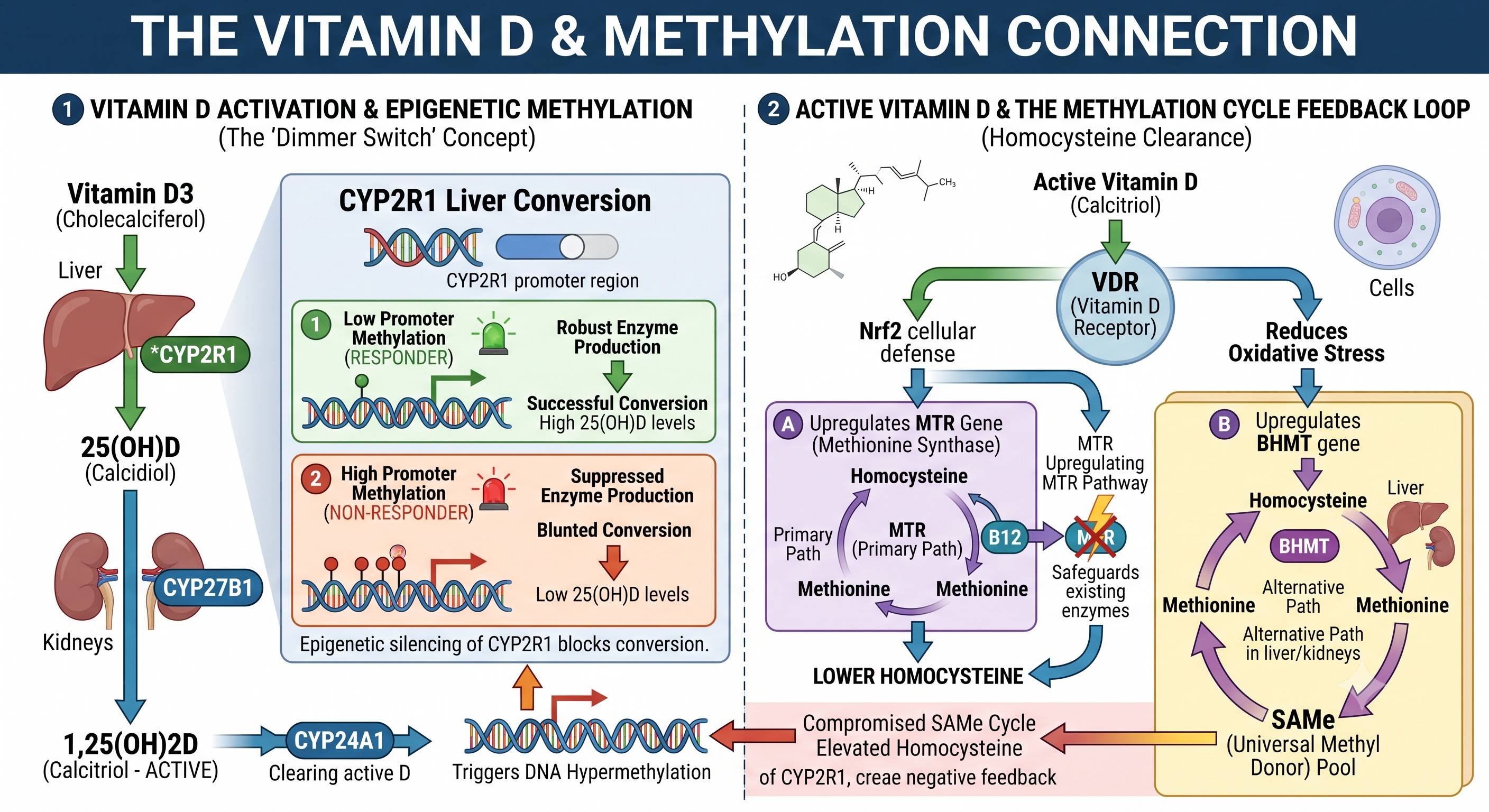
Yes, methylation directly and significantly impacts how efficiently your body converts Vitamin D3 into its active, usable form. This relationship operates on two distinct levels: epigenetic DNA methylation (which acts as a volume knob for the conversion enzymes) and the cellular methylation cycle (which shares a profound reciprocal feedback loop with active Vitamin D).
To see exactly where methylation interferes, it helps to look at the standard two-step activation pathway:
- In the Liver: Vitamin D3 (cholecalciferol) is converted into 25-hydroxyvitamin D [25(OH)D, or calcidiol] primarily by the enzyme CYP2R1. This is what is measured on standard blood tests.
- In the Kidneys & Tissues: Calcidiol is converted into the biologically active steroid hormone, 1,25-dihydroxyvitamin D [1,25(OH)2D, or calcitriol] by the enzyme CYP27B1.
1. DNA Methylation (The Epigenetic "Dimmer Switch")
DNA methylation is an epigenetic mechanism where methyl groups are attached to a gene's promoter region, typically silencing or "turning down" its expression.- The "Non-Responder" Phenomenon: Clinical data shows that baseline DNA methylation levels at the promoter regions of the CYP2R1 gene heavily dictate how an individual responds to Vitamin D supplementation.
- Enzyme Suppression: If the promoter region of your CYP2R1 gene is hypermethylated (over-methylated), the gene is partially silenced. Your liver produces fewer 25-hydroxylase enzymes, making it highly inefficient at converting raw D3 into circulating 25(OH)D.
- The Data: In clinical trials comparing Vitamin D "responders" to "non-responders," responders had significantly lower baseline DNA methylation at the CYP2R1 promoter (around 8%), allowing for robust enzyme production. Non-responders had high baseline methylation (around 30%), severely blunting their body's ability to utilize oral D3.
- Deactivation Control: Methylation also regulates CYP24A1, the enzyme responsible for degrading and clearing active Vitamin D to prevent toxicity. Altered methylation here can cause the body to burn through active Vitamin D too quickly.
2. The Systemic Methylation Cycle Feedback Loop
While S-adenosylmethionine (SAMe) is not a direct chemical cofactor required for the hydroxylation reactions themselves (which rely on NADPH and the cytochrome P450 enzyme network), the systemic methylation cycle and Vitamin D share a massive reciprocal cross-talk mechanism.- Upregulating the Cycle via VDR: Once Vitamin D is successfully activated into calcitriol, it binds to the Vitamin D Receptor (VDR). This activated VDR complex directly upregulates the expression of the BHMT (Betaine-Homocysteine S-Methyltransferase) gene.
- Protecting the SAMe Pool: BHMT is a crucial enzyme in the liver and kidneys that converts homocysteine back into methionine via an alternative pathway. Methionine is the direct precursor required to generate SAMe, your universal methyl donor.
The Vitamin D "Non-Responder": Is Your DNA Dimming Your Supplement’s Power?
Yes, higher active Vitamin D3 levels consistently cause homocysteine levels to drop.
Large-scale observational studies and gold-standard randomized controlled trials (RCTs) confirm a distinct, inverse relationship: as your Vitamin D status optimizes, circulating total homocysteine decreases. When active D3 binds to the Vitamin D Receptor (VDR), it triggers specific genetic and cellular actions that clear homocysteine through multiple pathways.
The Biological Mechanisms
Active Vitamin D doesn’t just lower homocysteine through one pathway; it exerts a multi-pronged push to keep the toxic amino acid from accumulating.1. Upregulation of Methionine Synthase (MTR)
While active D3 supports the alternative BHMT (betaine) pathway, recent molecular research highlights an even more direct impact on the primary, folate-dependent remethylation loop.- The active Vitamin D/VDR complex activates Nrf2 (a master antioxidant and cellular defense transcription factor).
- This Nrf2 activation directly binds to and upregulates the promoter region of the MTR gene (Methionine Synthase).
- More MTR enzymes mean your cells can rapidly pull homocysteine out of circulation and convert it back into methionine using 5-MTHF and Vitamin B12.
2. Safeguarding Enzyme Function via Oxidative Stress Reduction
The primary enzyme responsible for clearing homocysteine, Methionine Synthase, is incredibly sensitive to oxidative stress. Under high inflammation or oxidative conditions, the cobalt atom at the heart of its B12 cofactor becomes oxidized, completely disabling the enzyme and causing a major homocysteine backup.- Active D3 acts as a potent systemic anti-inflammatory.
- Clinical trials show that when Vitamin D drops markers like C-Reactive Protein (CRP), it lowers cellular oxidative stress.
- This environment keeps your existing MTR and MTRR (Methionine Synthase Reductase) enzymes fully active and running smoothly.
3. Preserving Liver and Kidney Function
The alternative remethylation pathway, BHMT, operates almost exclusively in the liver and kidneys. If these organs experience structural or metabolic strain, their capacity to process homocysteine drops drastically. Active Vitamin D protects hepatic and renal tissue architecture, ensuring the local cellular machinery required for the betaine-homocysteine conversion remains functional.What the Clinical Trials Show
In human trials, the drop isn't just theoretical - it's highly measurable.The Clinical Evidence: In double-blind, randomized, placebo-controlled trials, individuals with low baseline Vitamin D and elevated homocysteine were given high-dose Vitamin D3 (e.g., 50,000 IU weekly) over a two-month period. The treatment groups consistently showed statistically significant drops in total serum homocysteine, alongside reductions in body mass index (BMI) and systemic inflammatory markers, while the placebo groups saw no change.
If someone is dealing with stubborn hyperhomocysteinemia (elevated homocysteine) and pushing hard on methylated B-vitamins (like methylfolate and TMG/betaine) without seeing their numbers budge, a hidden Vitamin D deficiency or a high-methylation genetic barrier at the CYP2R1 liver enzyme is very frequently the missing link.
Summary:
The relationship between Vitamin D3 activation and the body's biochemical pathways operates as a highly coordinated, reciprocal feedback loop. On an epigenetic level, DNA methylation acts like a cellular dimmer switch for the liver enzyme CYP2R1, which is responsible for converting raw D3 into its circulating form. When the promoter region of this gene is heavily methylated, enzyme production is suppressed, explaining why some individuals act as clinical "non-responders" who struggle to raise their blood levels even with high-dose supplementation. Once Vitamin D is successfully activated, however, it turns around and directly reinforces the systemic methylation cycle by binding to the Vitamin D Receptor (VDR) and upregulating the BHMT gene, which is vital for maintaining the body's universal methyl donor (SAMe) pool.
Conversely, maintaining robust levels of active Vitamin D3 plays a direct, clinically proven role in forcing circulating homocysteine levels to drop. When active D3 binds to its receptor, it triggers a multi-pronged clearance strategy by activating the Nrf2 cellular defense pathway, which upregulates Methionine Synthase (MTR) - the primary enzyme that converts toxic homocysteine back into harmless methionine. Furthermore, by acting as a powerful systemic anti-inflammatory, active Vitamin D lowers the oxidative stress that would otherwise oxidize and disable the delicate B12 cofactors inside these clearance enzymes. This dual action of increasing enzyme production while shielding existing enzymes from environmental damage explains why clinical trials consistently show significant reductions in serum homocysteine when Vitamin D status is optimized.
Coenzyme B-Complex 120 Veg Caps
Methyl B-12 Plus Methyl Folate 60 ct
TMG (Trimethylglycine) 1000 mg 100 Tabs