What Is Alfalfa (Medicago sativa)? Botanical Heritage & the "Father of All Foods"
Alfalfa (Medicago sativa), historically referred to as Lucerne, purple medic, or California clover, is one of the most chemically diverse and nutrient-dense leguminous perennials in botanical history. Cultivated for over 1,500 years across Western Asia and the Mediterranean basin, the herb derived its common name from the Arabic phrase al-fac-facah, translating literally to the "father of all foods."
The remarkable nutritional concentration of alfalfa is a direct consequence of its extensive root architecture. The taproot of mature Medicago sativa can penetrate depths of 20 to 30 feet (6 to 9 meters) beneath the topsoil. This allows the plant to absorb deep-strata minerals, trace elements, and micronutrients inaccessible to shallow-rooted flora, sequestering them into its sun-ripened green leaves.
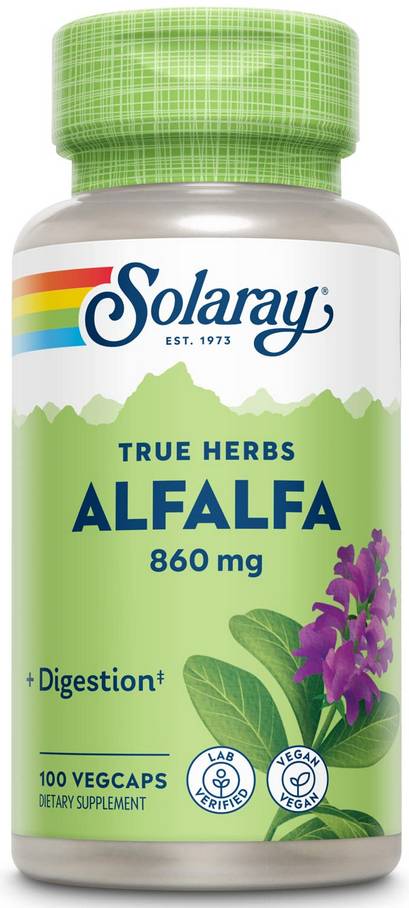
Solaray® Alfalfa Leaf 430 mg delivers pure, dried whole leaf in easy-to-digest gelatin capsules. Note: While historically indexed under legacy catalogs as "Alfalfa 1000mg," the precise lab-verified potency of this Solaray formulation is 430 mg of pure Medicago sativa leaf per capsule (providing 860 mg per standard 2-capsule serving).
Complete Ingredient Listing & Phytochemical Composition
Solaray adheres to strict identity and purity verifications. Below is the full supplement declaration alongside a biochemical breakdown of the naturally occurring compounds found within whole alfalfa leaf.
| Supplement Facts |
| Serving Size: 2 Capsules | Servings Per Container: 50 |
| Active Ingredient |
Amount Per Serving |
% Daily Value |
| Alfalfa (Medicago sativa) (leaf) |
860 mg |
* |
| * Daily Value (DV) not established. |
Other Ingredients: Gelatin (Capsule).
Solaray Purity Standards: Non-GMO, zero artificial excipients, no synthetic binders or fillers. Lab-tested for heavy metals, microbes, and botanical authenticity.
|
Unlike synthetic vitamin isolates, whole alfalfa leaf provides a broad spectrum of bioavailable co-factors, plant pigments, and secondary metabolites:
Evidence-Based Health Benefits & Mechanisms of Action
1. Supports Healthy Cholesterol & Lipid Balance
The primary mechanism by which Medicago sativa supports healthy cardiovascular function is its high concentration of triterpenoid saponins. Clinical trials have demonstrated that alfalfa saponins possess a unique molecular lipophilic affinity: they bind directly to free cholesterol and endogenous bile acids within the intestinal lumen.
By forming unabsorbable, insoluble complexes, alfalfa prevents dietary cholesterol from crossing the brush border membrane into systemic circulation, directing it instead toward fecal excretion. Consequently, the liver must divert circulating low-density lipoprotein (LDL) to synthesize new bile acids, naturally promoting balanced total cholesterol and LDL fractions without lowering beneficial high-density lipoprotein (HDL) levels [Malinow et al., 1987].
2. Natural Micronutrient Repletion & Alkalizing Support
Due to contemporary agricultural soil depletion, many modern diets lack sufficient trace mineral diversity. Alfalfa leaf provides an organic, bioavailable whole-food matrix that supports cellular homeostasis and tissue remineralization. Its high alkalizing potential helps buffer metabolic acidity, making it a foundational botanical for joint support, athletic recovery, and systemic mineral balance.
3. Glycemic Regulation & Metabolic Homeostasis
Traditional ethnobotanical applications of alfalfa for metabolic balance have been corroborated by biochemical research. Preclinical investigations show that water-soluble extracts of Medicago sativa improve peripheral glucose handling. Compounds within the leaf stimulate physiological insulin release from pancreatic beta-cells and enhance insulin-mediated glucose transport in skeletal muscle tissue [Swanston-Flatt et al., 1990; Khaleel et al., 2015].
4. Endocrine Support for Menopause & Hormonal Equilibrium
Alfalfa leaf contains safe, bio-identical phytoestrogens, predominantly isoflavones and coumestrol. These compounds act as selective estrogen receptor modulators (SERMs), binding weakly to both ER-alpha and ER-beta receptors. In women transitioning through perimenopause and menopause, alfalfa’s mild estrogenic buffering capacity has been shown in clinical trials to help diminish the frequency and severity of hot flashes and night sweats [De Leo et al., 1998].
5. Gastrointestinal Motility & Gentle Detoxification
With natural plant fiber, chlorophyll, and trace proteolytic and amylolytic enzymes, alfalfa leaf aids gastrointestinal transit, soothes the stomach mucosa, and mitigates symptoms associated with sluggish digestion and abdominal bloating.
Important Safety Information, Contraindications & Drug Interactions
Clinical Notice: Understanding L-Canavanine (Leaf vs. Seed/Sprouts)
A persistent point of confusion in nutritional literature involves the amino acid analog L-canavanine. Scientific research demonstrates that L-canavanine is concentrated almost exclusively in the seeds and young raw sprouts of the alfalfa plant, functioning as a botanical defense mechanism. High ingestion of L-canavanine from seeds has been linked in clinical case studies to the exacerbation or reactivation of Systemic Lupus Erythematosus (SLE) [Prete, 1985].
Solaray Alfalfa utilizes the mature aerial leaf (Medicago sativa leaf), where L-canavanine concentrations are virtually undetectable. However, individuals with autoimmune diseases must still exercise caution. Furthermore, historical claims suggesting canavanine cures leukemia or internal malignancies are not supported by modern oncology guidelines and should never replace standard medical care.