|
Search Term: " Slash "
The 5,000 mg Potassium Target: Why You Don't Need a Low-Sodium Diet   
Date:
June 19, 2026 12:22 PM
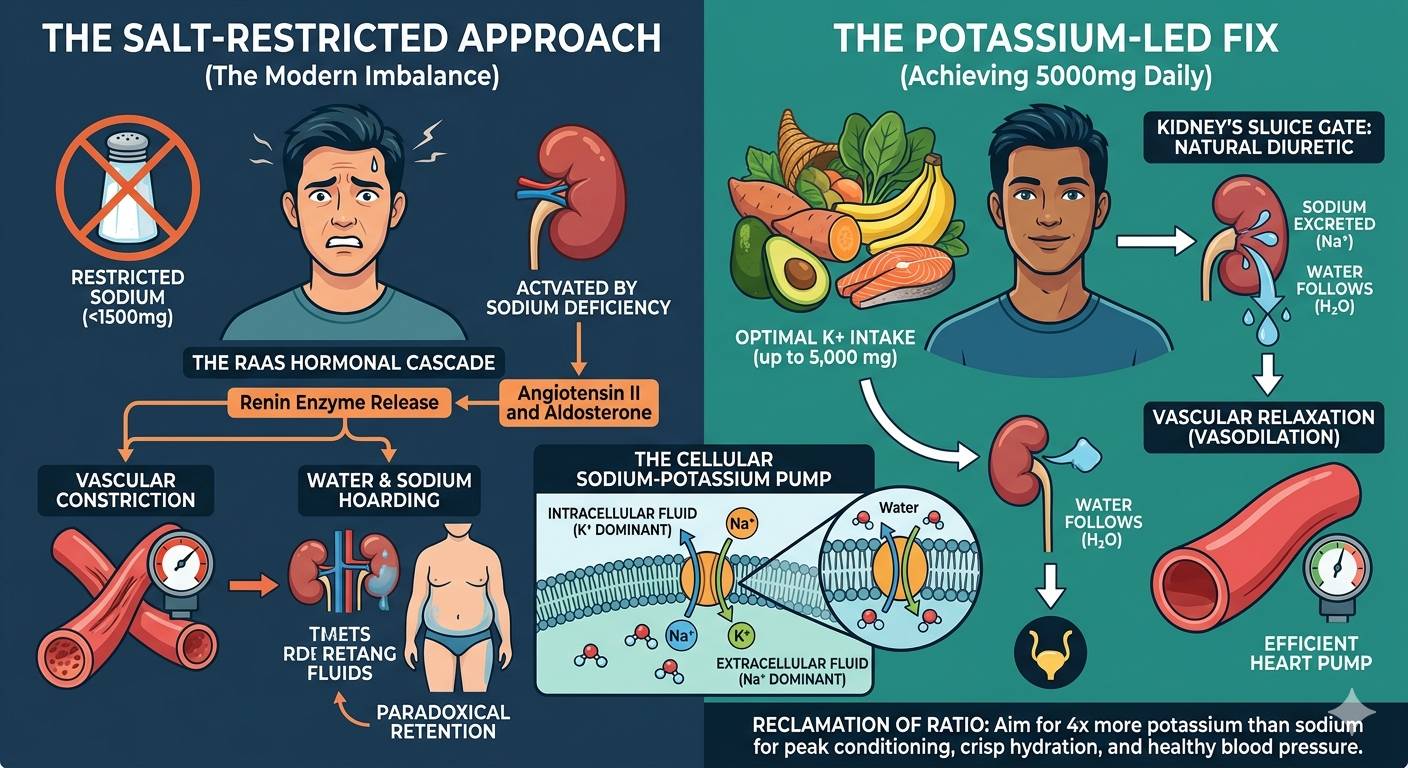
Here is exactly how it manages your water balance and keeps cardiovascular pressure in check. 1. Restoring Cellular Water BalanceTo understand fluid balance, you have to look at where water lives in the body. Sodium dominates the fluid outside your cells (extracellular), while potassium is the absolute ruler of the fluid inside your cells (intracellular).They control fluid movement via a cellular mechanism called the sodium-potassium pump. This microscopic pump works continuously to push sodium out of your cells and pull potassium in.
2. Lowering Blood Pressure: The Dual MechanismWhen your sodium-to-potassium ratio gets skewed in favor of sodium, your blood pressure inevitably creeps up. Potassium actively forces blood pressure down through two primary physiological pathways:Kidneys and Sodium ClearanceYour kidneys are responsible for filtering your blood and managing fluid volume. High sodium levels signal the body to hold onto water, which increases overall blood volume. Think of it like turning up the water pressure in a garden hose - more fluid equals higher pressure on the arterial walls.Potassium acts as a natural diuretic. When you consume enough of it, the kidneys are signaled to excrete excess sodium through your urine. As sodium leaves the building, it takes that excess water volume with it, dropping the pressure inside your cardiovascular system. Vascular Relaxation (Vasodilation)Beyond just managing fluid volume, potassium has a direct, relaxing effect on the physical structure of your blood vessels. High sodium and low potassium can cause blood vessel walls to become stiff and constricted.Potassium relaxes the smooth muscle cells lining your arteries. This widening of the blood vessels - known as vasodilation - instantly reduces resistance to blood flow, allowing your heart to pump more efficiently with less strain. The Ratio Advantage: Clinical research consistently shows that focusing on the ratio of sodium to potassium is often more impactful for blood pressure management than simply cutting out salt entirely. For optimal cardiovascular and metabolic function, aiming for a 2:1 intake of potassium to sodium is an ideal target. Vascular Health Beyond Low-Salt: How Potassium Relaxes Arteries and Keeps Muscles FullFor decades, the standard advice for managing fluid retention and high blood pressure has been a blanket directive: cut the salt. But treating sodium like a dietary villain ignores a fundamental biological truth - sodium is an essential electrolyte required for nerve transmission, muscle function, and blood volume regulation.Aggressively Slashing salt is a blunt instrument that often creates new physiological imbalances. The real key to vascular health and crisp fluid dynamics isn't absolute sodium deprivation; it is maintaining a high potassium intake - up to 5,000 mg daily - to allow your body to balance salt levels naturally. The Hidden Risks of Aggressive Salt RestrictionWhen you drastically cut sodium, your body doesn't just quietly lower your blood pressure. It views the sudden drop in a critical electrolyte as a survival emergency and activates the Renin-Angiotensin-Aldosterone System (RAAS).
Why 5,000 mg of Potassium is the Real SolutionInstead of forcing your body into a low-sodium starvation state, a more effective approach is to supply it with the optimal amount of its natural physiological counterweight: potassium. Aiming for a robust target of 4,700 to 5,000 mg of potassium daily changes how your system processes salt.
The Cooperative Electrolyte RelationshipSodium and potassium should never be viewed as enemies; they are partners that require a specific ratio to optimize human physiology.
Aggressive dietary salt restriction often backfires because sodium is an essential electrolyte required for nerve transmission and fluid regulation; cutting it too drastically triggers a survival response that constricts blood vessels and hoards water. Fluid balance is ultimately determined by the relationship between sodium outside the cells and potassium inside them, a delicate equilibrium managed by the cellular sodium-potassium pump. When this ratio is skewed by a lack of dietary potassium, cells lose their optimal hydration, causing extracellular fluid retention and the soft, bloated look of subcutaneous water weight. Rather than starving the body of salt, driving daily potassium intake up to 5,000 mg fixes this modern imbalance and naturally eases blood pressure through a dual mechanism. This high intake acts as a natural diuretic, signaling the kidneys to flush out excess sodium along with the excess blood volume that strains arterial walls. Simultaneously, potassium promotes vasodilation by relaxing the smooth muscle lining of the blood vessels, reducing vascular resistance and allowing the heart to pump efficiently while keeping muscles full, hydrated, and performing at their peak.
(https://vitanetonline.com:443/forums/Index.cfm?CFApp=1&Message_ID=6642) Powerful organic compounds in cannabis can slash some cancers by 50%, researchers say! 
Date:
January 19, 2019 10:52 AM
Terpenes is a compound found in citrus fruits, rosemary, frankincense, and cannabis. Because it includes many compounds including THC, ketones, esters, lactones, and THC not found together in the same rate in other plants, it is a better health treatment than anything created by the pharmacy companies. Terpenes also has limonene and pinene, which help with anti-inflammation in healing cancers, and reducing stress. Joy Smith shares a story of having cancer, trying chemotherapy and being given just weeks to live, but attributes cannabis oil to saving her. Key Takeaways:
"Medical marijuana is a booming industry, and the use value of cannabis just continues to expand as we learn more about this heavily prohibited, but clearly medicinal, plant." Read more: https://www.naturalnews.com/2018-11-23-organic-compounds-in-medical-cannabis-slash-some-cancers.html
(https://vitanetonline.com:443/forums/Index.cfm?CFApp=1&Message_ID=5978) Daily green tea consumption found to slash dementia risk by up to86%
Date:
January 10, 2019 04:26 PM
Green tea has long been touted for its many health benefits. It is full of antioxidants that help remove oxidation and free radicals from the body system. New studies reveal that it is also very effective in offsetting the risk factors of developing dementia later in life. Dementia effects the brain's memory system and in later stages the body's neurological system. Green tea helps to break down the plaque like build up of beta amyloid in the brain by over 80% and reducing the risk of development of dementia by over 50% in patient populous with a genetic history. Key Takeaways:
"Beta-amyloid plaques is shown to trigger the onset of cognitive disorders in patients. Researchers note similar effects regardless of whether the tea was green or black." Read more: https://www.naturalnews.com/2019-01-02-daily-green-tea-consumption-found-to-slash-dementia-risk-by-up-to-86-percent.html
(https://vitanetonline.com:443/forums/Index.cfm?CFApp=1&Message_ID=5953) Prevent the number one cause of premature death by simply takingvitamin C
Date:
November 16, 2018 09:51 AM
According to the data, it's been estimated that as many as half of all premature deaths are preventable, moreover that poor nutritional intake is at the core of the problem. One such nutritional deficit that could lower the number of premature deaths is the deficit of vitamin C. Vitamin C is a well-known immune system booster. However, it also has an important role to fulfill when it comes to cardiovascular health. The journal of the American College of Nutrition recently attests to this fact. The journal reported findings that agreed that the use of vitamin C reduced the incidence of cardiac disease. The findings were based on a study of over 100 men, many of whom were smokers. Those given the highest dosage of vitamin C slashed their risk for cardiac complications by more than half. Danish research further augments this aspect of vitamin C. Data pools acquired from 100,000+ Danes showed high vitamin C concentrations among those who regularly consumed a large array of fruits and vegetables. This higher level was auspiciously linked with a lowered risk of cardiovascular disease and premature death. Key Takeaways:
"The reality is that an inexpensive vitamin supplement could reduce the rate of coronary heart disease but mainstream medicine is so deeply entrenched in pharmaceutical dogma, the idea that nutrients can prevent disease is downright blasphemous." Read more: https://www.naturalnews.com/2018-11-12-prevent-number-one-cause-of-premature-death-vitamin-c.html
(https://vitanetonline.com:443/forums/Index.cfm?CFApp=1&Message_ID=5836) Consuming Cannabis Could Slash Your Chances Of Blood Clots, Stroke: Study
Date:
September 15, 2017 09:14 AM
As possession of cannabis slowly starts to become legal, it is important to be aware of the possible effects in those who use the drug. Recent studies have revealed that cannabis may actually contribute to health by potentially decreasing the likelihood of stroke and contribute to brain activity. In a study involving 175 volunteers, researchers observed that cannabis users had an increased systemic flow of blood and oxygen, including within the brain, specifically around the forebrain, related to learning. In addition, head researcher, Dr. Francesca Filbey, states that the primary ingredient in cannabis is tetrahydrocannabinol (THC) which dilates blood vessels, causing a drop in blood pressure, and increasing blood flow. Key Takeaways:
"Past marijuana research has shown changes in cognitive functions such as memory and executive functioning," Read more: https://www.civilized.life/articles/consuming-cannabis-could-slash-your-chances-of-blood-clots-stroke-study/
(https://vitanetonline.com:443/forums/Index.cfm?CFApp=1&Message_ID=5247) Mediterranean Diet found to slash risk of dementia by 35%
Date:
July 22, 2017 09:14 AM
According to a study by the University of California following a Mediterranean diet could significantly reduce the risk of dementia. Other studies seem to agree that a diet low in meat and dairy but is rich in fresh fruit and vegetables, beans, nuts, and healthy fats significantly reduce the risk of cognitive decline. There are some studies showing that there is marked improvement in cognition when a person strictly adhered to the diet as well as decreasing inflammation, reducing obesity, healthier lipid panels and such. Key Takeaways:
"The Mediterranean diet, which includes mostly oily fish, vegetables and nuts, has long been touted as a highly effective diet scheme against a plethora of diseases." Read more: http://www.naturalnews.com/2017-07-19-mediterranean-diet-found-to-slash-risk-of-dementia-by-35.html
(https://vitanetonline.com:443/forums/Index.cfm?CFApp=1&Message_ID=5014) Study: Turmeric can Slash your Heart Attack Risk by 56%
Date:
March 16, 2017 02:44 PM
Tumeric is a colorful herb that is used in many dishes, particularly Asian foods. It adds awesome flavor to a dish, which hints at a kick of spice. What makes a dish better? New evidence suggests that consumption of tumeric has an array of health benefits for you to enjoy. One of the best is a reduction in your risk of heart attack. Studies show that you decrease heart attack risk considerably when you consume Tumeric. What are you waiting for? Key Takeaways:
"This incredible ability of curcumin has been particularly helpful for postmenopausal women who reach the age where heart problems can arise and become a health concern." Read more: http://www.healthnutnews.com/study-turmeric-can-slash-heart-attack-risk-56/
(https://vitanetonline.com:443/forums/Index.cfm?CFApp=1&Message_ID=4179) Rewires Your Brain and Slashes Anxiety Levels, but Beware
Date:
March 14, 2017 03:59 PM
Thedocumentary, Ride the Tiger: A Guide Through the Bipolar Brain, focused on current concepts treatment. Drugs available don't work in all patients and lifestyle changes are recommended when possible. It's recommended that bipolar patients and people suffering from other disorders There has been some positive outcomes from devices using light and magnets to stimulate the brain but a healthy diet, exercise, vitamin supplements and probiotics can address these disorders. Patients have also received benefits through exercise and proper sleep patterns. Doing all this, patients have found they can slowly get off their drug treatment regimens. Key Takeaways:
""By seeking to understand how the bipolar brain malfunctions, researchers believe they can get closer to understanding the inner workings of the brain, potentially unlocking treatments for other types of psychiatric problems as well."" Reference: //www.healthnutnews.com/rewires-brain-Slashes-anxiety-levels-beware/
(https://vitanetonline.com:443/forums/Index.cfm?CFApp=1&Message_ID=4150) Vitamin C is a powerful heart healer, especially after surgery
Date:
February 13, 2017 01:19 PM
Vitamin C has long been known to have healing properties. It boosts the immune system. We are told to use it when we're having a cold or other illness. It is apparently also good for healing the heart. Surgery can be hard on the heart and vitamin C is helpful at this time. Key Takeaways:
"A new study, published in the journal BMC Cardiovascular Disorders, found that oral administration of supplemental vitamin C after heart surgery could Slash the risk of AF by up to 73 percent in high-risk patients, without adding side effects." Reference: //www.naturalnews.com/2017-02-10-vitamin-c-is-a-powerful-heart-healer-especially-after-surgery.html
(https://vitanetonline.com:443/forums/Index.cfm?CFApp=1&Message_ID=3934) Olive oil could slash your chance of bone fractures in half, study says
Date:
February 01, 2017 12:59 PM
Extra virgin olive oil could have better benefits besides making your meals taste better. A recent study found that people who regularly consume EVOO have a decreased risk of osteoporosis and bone fracture. When regular olive oil was analyzed, it was not found to have the same benefits. The reason behind this difference is believed to be due to the greater amount of processing. The olives that are pressed into EVOO contains the highest amounts of antioxidants and bio-active compounds. Key Takeaways:
"Eating more extra virgin olive oil could cut your risk of osteoporosis related fractures, says a new study." Reference:
(https://vitanetonline.com:443/forums/Index.cfm?CFApp=1&Message_ID=3866) Chamomile: What You May Not Know! 
Date:
September 16, 2016 09:52 AM
Chamomile is an excellent tea that everybody should have at their disposal when you need to relax and calm down from a busy stressful work day. The Tea is great tasting and easy to make.
(https://vitanetonline.com:443/forums/Index.cfm?CFApp=1&Message_ID=3293) | ||||||||||||||||||||||||||||||||||||||||||||||||||||||||||||||||||||